Advocates call for the full implementation of an expert report on special care, and welcomed plans for legal reform to get state agencies working together.
The government seems to be considering making helmets and hi-vis mandatory for people using some category of bikes, though it’s not totally clear which.
On Wednesday morning, the halls of Our Lady of Mercy College in Beaumont bustle as one class ends and another is about to begin.
Between mock exams for third and sixth years, a science festival and the normal day-to-day of the college, there is plenty happening, says Sarah Keegan, a fifth-year student.
Outside of normal schoolwork, Keegan also has her own project that keeps her busy, she says.
She is a member of the school’s Eco Committee, as are her friends Alexandra Burke-Hosey and Grace Collier.
This year, they set a new goal for themselves – to get the school and everyone in it to recycle better.
During the pandemic years, priorities in the school shifted as emergency, short-term public-health measures superseded long-term eco goals, says Hilary Taylor, a teacher who also oversees the Eco Committee.
“The priority was to keep everyone safe and well,” she says.
Between all the face masks and the never-ending streams of blue-roll used to wipe surfaces, recycling went on the back burner for a lot of people, she says.
Until the Eco Committee decided they had to do something about it, she says. “The girls pick a topic that they’re interested in.”
In order to ensure the continuation of life on this planet, everybody has to get involved, says Collier, one of the girls.
“Especially the younger generation, because they're going to have to take care of the planet next and try to fix what has already been done,” she says.
So, the girls decided it’s important to show their fellow students why it’s important to do something, however small, to improve their own little patch of the world.
“People might say, ‘It doesn't matter what bin that goes in’. But it does,” says Collier.
For the bees
For Keegan, Burke-Hosey and Collier, their interest in environmental issues grew from their love for animals, the trio agree.
“We saw that animals were really impacted by negative effects of climate change and global warming,” says Keegan.
She points to the example of the red squirrel, native to Ireland, and a species in decline. As their natural habitat shrinks, the invasive grey squirrel has been muscling in, hoovering up the food supply of its red-coated rivals.
And there's the great yellow bumblebee, she says.
“Because the flowers are decreasing as there's more urbanisation,” she says. “There's less forests and plants; the bees are really badly affected.”
Then there are those awful, rotten landfills, says Burke-Hosey.
“They obviously smell and look bad. But they also release emissions into the air that cause air pollution, and respiratory issues,” she says.
Then there is the fact you have to cut down trees and clear land to install a landfill, adding to more biodiversity-loss, she says.
Recycling also creates way more employment for people than landfills or incinerators do, Burke-Hosey adds.
The girls all acknowledge the housing crisis and the need for housing in their area, but want to make sure it all happens with one eye firmly on the environment and the maintaining of vital habitats.
“If we don't care, no one will,” says Collier.
Can-ye West
Carefully laid out all across the school, never too far from reach, are bins.
You’d expect to find bins in any school, or any public place, but in Our Lady of Mercy College in Beaumont there are a lot of bins.
Carefully curated bins.
With colourful posters and signs to let students know which bin is for what, but also with lots of other eco-friendly info.
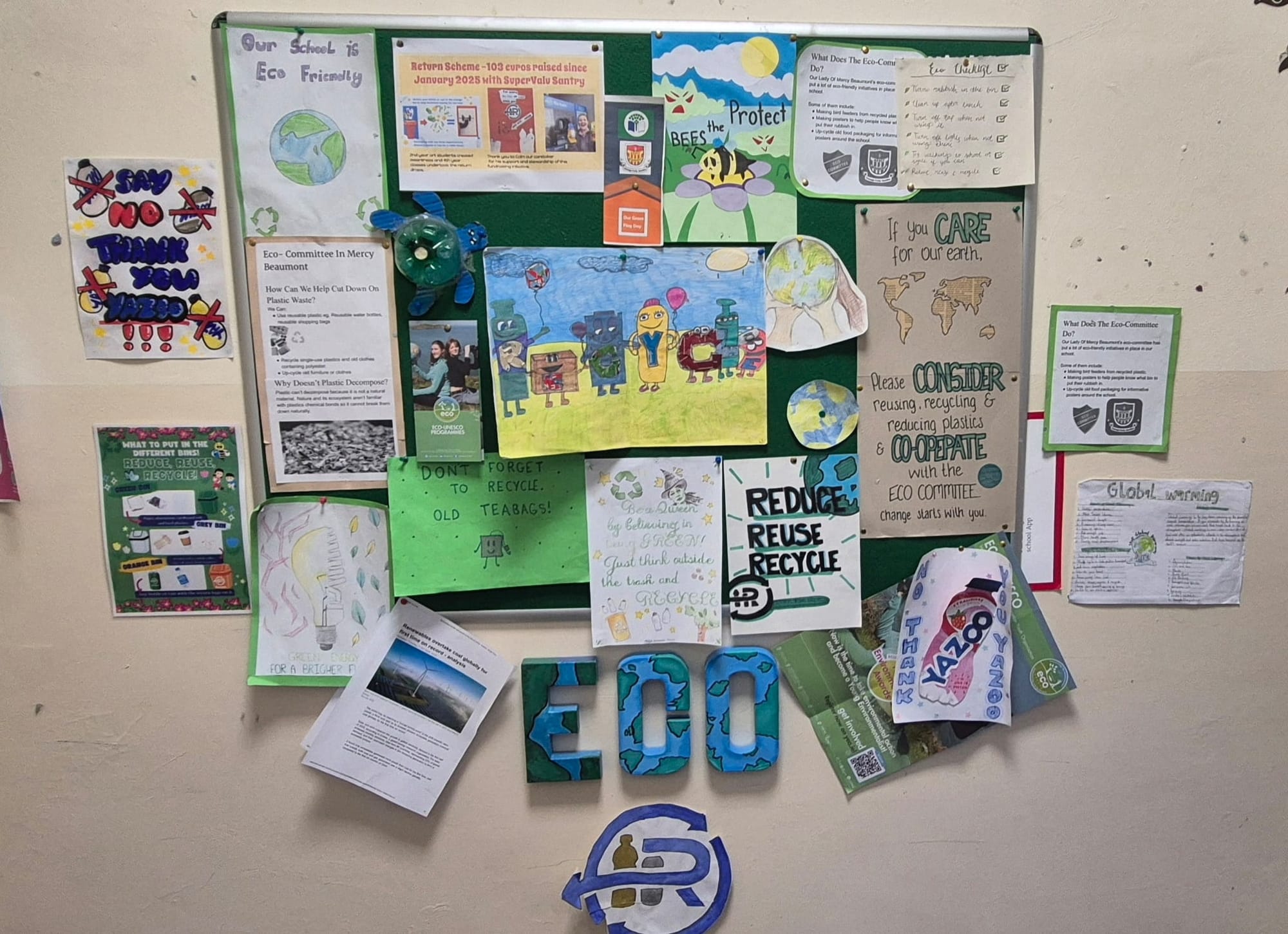
And while they have information posted across the school, the Eco Committee also has its own dedicated notice board – with information, encouragement, and even tips to avoid certain products.
Photo by Eoin Glackin.
Among the general, compost and recycling bins, there are also special ones dedicated to the Re-turn scheme.
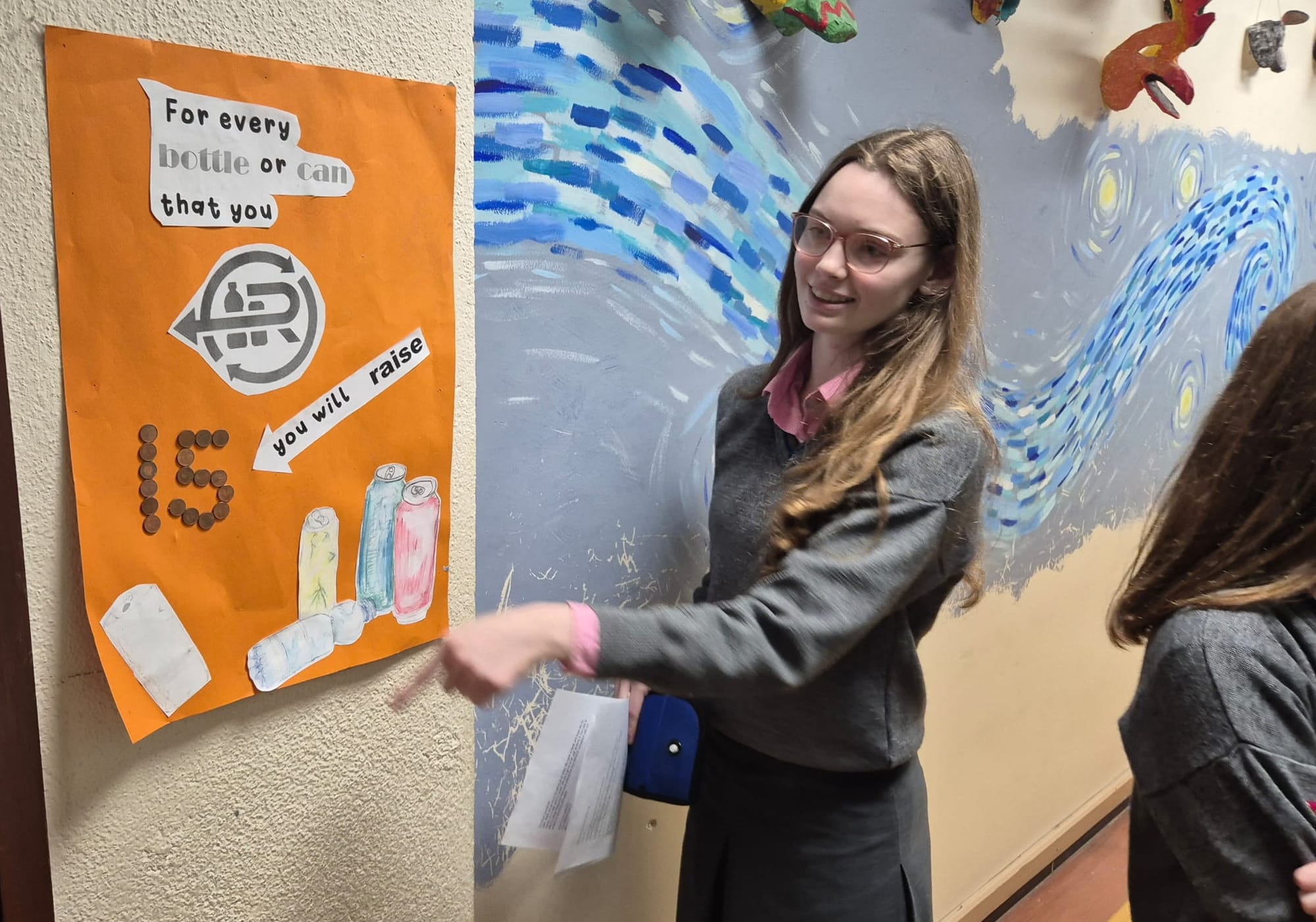
That’s the government’s deposit return scheme that puts a 15 cent or 25 cent levy on bottles and cans, size-dependent, which can be claimed back when recycled at specific machines.
The transition year members of the Eco Committee are tasked with regularly emptying the bottles and cans from these Re-turn bins and exchanging them for cold, hard cash.
The money raised goes back into the school, paying for things like gym equipment, Keegan says.
Sarah Keegan promoting the Re-turn scheme, which the students use to pay for things around the school. Photo by Eoin Glackin.
Although the bins are all clearly labelled, the girls say they also make sure that general and recycling have their own separate colour bin bags, to make things easier on the cleaning staff.
“They have enough to be worried about,” says Burke-Hosey.
To keep the message out there, the Eco Committee also hold raffles on a Monday in the canteen, the girls say.
When people drop an item in the recycling or Re-turn bin, they get a raffle ticket for a Penneys voucher, they say.
Elsewhere, they’ll hold workshops, making bird feeders out of plastic bottles, or making dolls out of tin cans and old pieces of their school uniforms.
One such doll was named Can-ye West, says Burke-Hosey, with a chuckle.
There is a culture of eco-friendliness embedded into lots of aspects of the school life, says Collier.
Like in transition year, she says, when students can take part in workshops dedicated to “reloving” or “upcycling” old clothes. Turning old throw-aways into new, fun garments.
Burke-Hosey says she has been involved in setting up and running three different student companies over the years, as part of the school’s business programme.
And they are always encouraged to keep things as environmentally friendly as possible, from manufacturing to packaging.
One year, her group started a candle-making business, using soy wax, which is much better for the planet than bees’ wax, she says.
Small changes
Working on something positive together makes them feel more at ease with the current state of climate change, the girls all agree.
Research by Swedish psychologist Maria Ojalashows that young people who use “meaning-focused coping” — a way of finding purpose, values, or hope in a particular situation — experience less distress and more optimism, purpose and life satisfaction.
There is a conscious effort to balance those things in the school, says Taylor, the teacher.
When it comes to communicating with the younger students about these issues, it’s done by the older girls from the committee.
“If it's student-led, I think it can come across a little bit better, because they can relate to maybe the concerns that the younger students have better than an adult,” says Taylor.
When there are presentations to be done, the students make them, she says.
It can be more comforting to hear things from students that they can relate to, she says.
The Eco Committee isn’t about doom and gloom, Keegan, Burke-Hosey and Collier all say.
They just want to encourage people to make small little changes in their habits, and to understand how big a difference that all of those little changes can make.
“It’s not that the people who live there don’t have cars,” he says. “It’s that the neighbourhood is not a car park, and the car parking is on the edge.”