Nicknamed “liquid handcuffs”, methadone can require daily doses at a pharmacy or clinic, making education, employment, or even a holiday hard to grasp.
What would become of the Civic Offices on Wood Quay if the council relocates?
After The Currency reported the idea of the council moving its HQ, councillors were talking about and thinking through the pros and cons and implications.
Dublin City Council's Civic Offices, with the newer Scott Tallon Walker building to the left, and a Stephenson bunker visible to the right. Photo by Sam Tranum.
On Wednesday, The Currencyreported that Dublin City Council is looking at relocating, leaving its Civic Offices on Wood Quay, in Dublin 8.
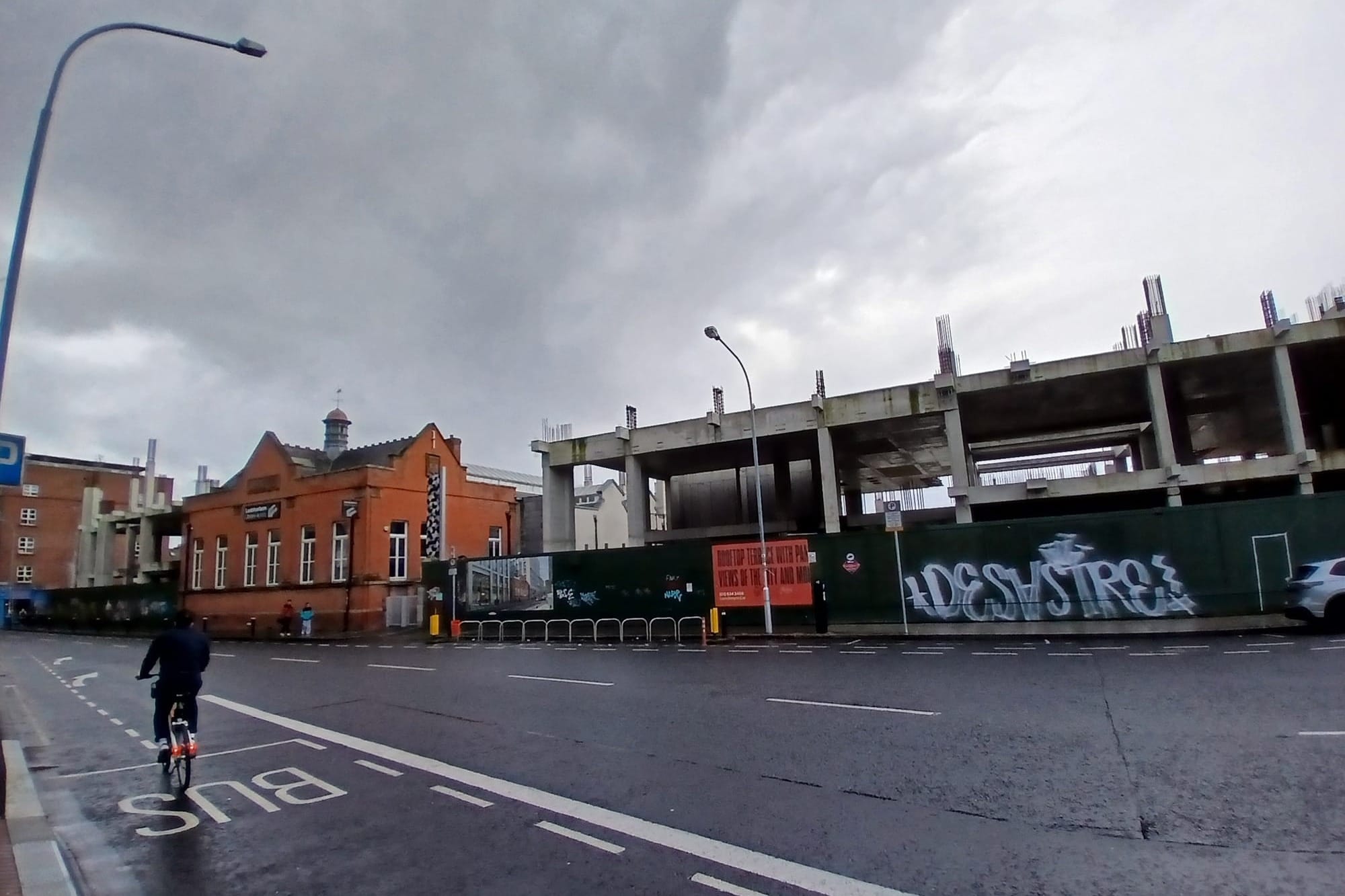
The idea is that, if the council manages to buy Camden Yards, a stalled mixed-use development on Kevin Street – a plan that was mooted some time ago – it could move its headquarters over there.
On Friday, an email sent to councillors on behalf of the council's chief executive, Richard Shakespeare, said the council is in exclusive discussions on Camden Yard.
"Heads of Agreement have been signed to facilitate a 10-week due diligence period," the email says. "The acquisition would enable the delivery of a new Civic Offices and 300 public homes on the Camden Yard site."
"Developing modern energy efficient accommodation at Camden Yard would significantly reduce our operational emissions while freeing the Wood Quay site for much-needed public housing," the email says.
Councillors said this idea is coming from the council’s executive, and that Shakespeare had talked to the group leaders – representatives of the parties and independent groups on the council – about it recently.
Some councillors said they supported the idea, while others were cautious, saying it was at an early stage, and they wanted more information.
“In general I think I favour what I am hearing but [it’s] all speculative at present,” said Labour Councillor Dermot Lacey.
“Nothing is agreed yet,” said Sinn Féin Councillor Daithí Doolan on Thursday. “This is a management proposal. I have sought a detailed briefing.”
On Friday, he put out a press release as Sinn Féin group leader, saying: "We are demanding a full council meeting as soon as possible, next week if possible, to discuss the whole process and hear at first hand the details of this multi million euro plan."
Questions various councillors raised included: What are the costs? And: If Dublin City Council moves out of its Wood Quay campus, what would be done with that site?
“My concern is what happens if you vacate a building of that size and scale in the city centre,” says Social Democrats Councillor Karl Stanley.
If the office buildings there are too old and rickety to meet the council’s needs, who would take them over instead? And if they’re to be knocked and the site redeveloped for housing, how could that actually be accomplished?
In the 1970s, there was a battle over whether to build the Civic Offices on the site, which hosted then – and continues to host – important Viking-era archaeological remains.
Frank McDonald, reported on it all for the Irish Press at the time. “When you think of all the trouble they had in securing the site for development, to walk away from it in its entirety is sort of astonishing,” he said Thursday.
A site with a history
Dublin City Council began exploring ways to consolidate its offices into one big mothership in 1939, according to a conservation report included in a 2020 planning application to update the creche in its Civic Offices on Wood Quay.
It started buying land on Wood Quay in 1956, and then held a competition to design and build it in 1968, which Sam Stephenson, of Stephenson and Gibney Architects, won, the report says. He designed four brutalist “bunkers”.
When the construction began, it revealed on the site “the core of the Viking and medieval site known as Dyflinn”, according to an archaeological report from the 2020 planning application.
“Other Recorded Monuments are also recorded within the complex,” the report says. “One of the most important findings was an extensive stretch of City Wall, constructed in c. 1100.”
These finds kicked off massive protests to preserve the remains, led by F.X. Martin, a priest, a professor of medieval history at University College Dublin, and chair of the Friends of Medieval Dublin.
McDonald recalls interviewing Martin as he headed a march against the planned development in September 1978. “He was dressed in his full clerical and academic regalia.”
For the September 1978 “Save Wood Quay” protest march, about 20,000 people took to the streets, according to History Ireland. There was also a three-week sit-in on the site by 52 protestors, “supported by thousands of members of the public”, it says.
While the core of the settlement was exposed during excavations, McDonald got a chance to walk through its streets, he says. “It was quite something to be able to walk along the wattle paths through Viking Dublin. It was really a privilege,” he said.
In the end, of course, the Civic Offices were built. First, two of Stephenson’s planned four “bunkers”. Then there was a change of course, and Scott Tallon Walker’s glass-fronted office building along the river was built, completed in 1994.
The National Inventory of Architectural Heritage lists these as “regional” architectural significance.
This “constitutes a ministerial recommendation for its inclusion on Dublin City Council’s Record of Protected Structures”, says the 2020 conservation report. Although it’s not listed (yet).
These days, it’s the headquarters for the council, with about 20,000 square metres of office space.
About a third of the council’s Wood Quay site remains “archaeologically unresolved”, according to McDonald. “The whole area that’s covered in grass on the hill, that whole area has yet to be excavated,” he says.
Giving the existing buildings another use
One possibility for the future of the Civic Offices, should the council leave them, is that someone could continue to use them as offices. But by who?
Dublin City Council apparently doesn’t want them.
“They basically want to move to more modern offices, which would be cheaper to run and nicer for people to work in,” says Stanley, the Social Democrats councillor.
The stalled Camden Yards project, surrounding the library on Kevin Street. Photo by Sam Tranum.
There are plumbing problems, says independent Councillor Mannix Flynn. Plus the spread-out layout of the campus is awkward, and there’s a lack of decent conference and meeting rooms, he says.
Of course, one possibility would be for the council to renovate the building to fix the problems and meet that target. But that’s hard to do while it’s fully occupied.
And Flynn, the independent councillor, says the cost of refurbishing would be higher than moving to another location – say, Camden Yards.
Doolan, the Sinn Féin councillor, said he wants more detail on the council’s case for moving out of Wood Quay instead of renovating it and staying.
“We will be asking why the management thinks the Civic Offices cannot be upgraded as required,” Doolan said. “We would want to see the facts and figures about the problems in Civic Offices and the cost to carry out refurbishment.”
On Wednesday, The Currency article put the cost of refurbishment at "over €250 million", but by Friday, in the email on Shakespeare's behalf, that cost had risen to "€350–€400 million".
Presumably, any potential public-sector tenant would have to take on that cost – which Dublin City Council doesn’t want – if they wanted to take over the buildings.
As for potential private-sector tenants, “If Dublin City Council are saying this isn’t fit for purpose, good luck getting Facebook in,” says Stanley, the Social Democrats councillor.
Furthermore, there’s been an oversupply of office space in Dublin in recent years, and a relatively high vacancy rate – so potential tenants have lots of other options.
From a low of under 10 percent in 2020, the vacancy rate for Dublin office space has been on the rise for several years, increasing “from 15.7% to 17.5% last year”, according to Savills 2025 Market Outlook report.
A report from the Central Bank last month says that “the central scenario for the Dublin office vacancy rate is a marginal rise to just over 19 per cent in 2026 before falling back below end of 2024 levels (18.6 per cent) by the end of 2027”.
Building housing
The idea seems to be to build housing on the site at Wood Quay, if the council moves its headquarters elsewhere.
"Relocating from Wood Quay would unlock the potential for an excess of 500 public homes on the current Civic Offices site, while enabling modern, sustainable workplaces for staff and improved public services for citizens," said the email sent on Shakespeare's behalf on Friday.
Flynn, the independent councillor, said he’d love to see social housing built on the site. Fine Gael Councillor Ray McAdam, the Lord Mayor, said similar.
“The main thing for me is that if this was to proceed, we’d make sure we could deliver social and affordable housing,” McAdam said Thursday.
Fianna Fáil Councillor Deirdre Heney says she’d “want to make sure some of the housing could be purchased, that it isn’t all social housing”.
What about the archaeological remains under the site, though?
“We’d have to do a feasibility study to establish what could be built,” McAdam said. “But given that the Civic Offices were built there in the past, you’d think that some kind of housing development would be possible.”
Said Heney: “We’d have to assume that the archaeological work is properly carried out and investigated.”
This might mean there’s a long-ish gap in time between the council moving out and the redevelopment of the site beginning. But Heney says, “if that’s the case, so be it”.
One factor that might play into that is whether the whole complex is going to be demolished and redeveloped or just parts.
“I wouldn’t be sad to see the bunkers go, but I can see no justification for taking down the office building on the quay,” said McDonald, the journalist.
“You have to think also about the embodied carbon, of which there is a hell of a lot in those bunkers,” he said.
Embodied carbon is the carbon dioxide emitted during the manufacture, transport and construction of building materials, as well as in the demolition of that building.
Rather than release loads of carbon dioxide into the atmosphere by demolishing a building and building a new one, it’s better in terms of carbon emissions to refurbish.
This is something the council already has been mindful of when deciding whether to demolish or refurbish old flat complexes.
And, reinforcing this, new EU rules, under the EU Energy Performance of Buildings Directive, call for the consideration of embodied carbon.
Then there’s the question of who is going to redevelop the site, and how they’re going to arrange the financing for that.
“I’d urge a lot of caution to the executive – I’d urge a lot of caution – it’s very hard to line up financing for such a big project,” said Stanley, the Social Democrats councillor.
One option would be for the council to take on the task of developing housing on the site itself, as it has at say, what’s now known as the Goldenbridge site, on Emmet Road in Inchicore. That’d be McAdam’s preference, he said.
If the council decided, instead, to sell the land, it would have to offer it to the Land Development Agency (LDA).
A spokesperson for the LDA has not yet responded to a query sent on Thursday afternoon on whether it would want the Wood Quay site.
In any case, Stanley says he “would be highly sceptical about any claims about social housing”.
“If you want to shut people up about debate about demolishing a building, you can just say, this is a housing crisis, we’re building social housing,” he said.
In addition to the prospect of housing on the site, another idea that’s been hinted at is some sort of Viking-related thing – presumably different to the nearby Viking-focused museum Dublinia.
Although none of these councillors mentioned the idea, the article in The Currency referred to the prospect that “Redoing Wood Quay could offer Dublin the chance to give its Viking heritage more space.”
Who has the power?
Councillors said it is the office of the council’s chief executive, Richard Shakespeare, that is driving the idea of leaving Wood Quay for Camden Yards.
Asked whether the council would need the Department of Housing’s approval to leave Wood Quay, or develop new offices at Camden Yards or elsewhere, a spokesperson for the department said no.
“Ministerial approval is not required in respect of the location or purchase of local authority offices and buildings – the Department does not have direct involvement or role in such matters,” he said. “Any proposal in respect of Dublin City Council headquarters is solely a matter for the local authority.”
This mostly means the council executive, but the elected members will likely be consulted, and their views might be taken into account. There are a couple of ways they might have actual power over events, as well.
If the council decides to sell or lease out the Wood Quay site, that would require a vote by councillors.
If any part of the deal requires borrowing, that would also require councillors’ approval.
And when the council develops projects on its own lands, it brings the plans to councillors for approval via the “part 8” planning process.
“The democratically elected Councillors are responsible for running the local authority in conjunction with the Chief Executive and his/her team,” the Department of Housing spokesperson said.
UPDATE: This article was updated on 19 December 2025 at 17.47 to include quotations from the email sent earlier that day on behalf of Dublin City Council's chief executive, Richard Shakespeare, and a press release from Sinn Féin Councillor Daithí Doolan.
Nicknamed “liquid handcuffs”, methadone can require daily doses at a pharmacy or clinic, making education, employment, or even a holiday hard to grasp.
The numbers spiked after a new cohort of councillors was elected in June 2024, and have eased somewhat since then – while remaining higher than before.