Opened in the 18th century, the graving docks are part of Ringsend’s Georgian maritime heritage, says Rachel Lopez of the Ringsend and District Historical Society.
Waterways Ireland cools on plan for sauna at Grand Canal Basin graving docks, considers working dry docks instead
Opened in the 18th century, the graving docks are part of Ringsend’s Georgian maritime heritage, says Rachel Lopez of the Ringsend and District Historical Society.
The front bar of the Marker Hotel was packed with people, chatting lively over drinks while icy gusts blew through Grand Canal Square outside on a Wednesday evening in mid-April.
Nearby, in the reception, somebody had put up a small sign, telling members of the Grand Canal Residents Association that their annual general meeting would take place in the hotel’s vast conference room.
Rows and rows of chairs were set out on a grey and black carpet that resembled cobblestones. A pair of women sat at a desk inside the door, taking the names of attendees, and passing out raffle tickets.
Up at the front of the long white-walled room, some lanyards bearing the names of local representatives were resting on the yellow cushioned chairs.
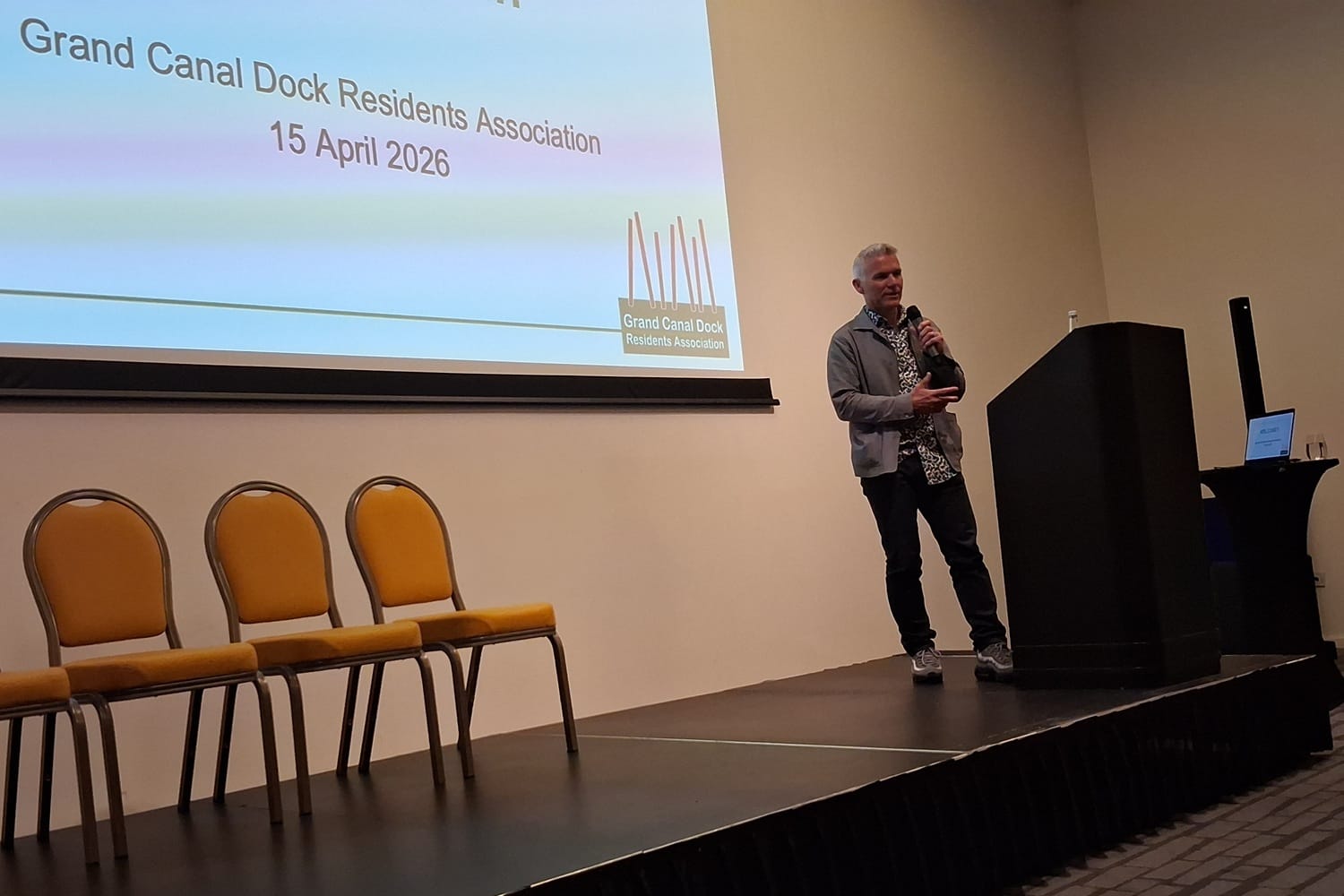
As 7.30pm came around, the association’s chairperson, Michael Ingle, took to the small black stage, standing between a lectern and a huge screen, onto which he had some slides projected.
They had some “hot issues” to discuss, including the long-discussed future of the graving docks, Ingle said, once the meeting was underway.
The docks sit on a tiny spit of land at the eastern end of Grand Canal Basin, between new Dublin and old Dublin, in a way. Between the shiny apartments and offices of the Silicon Docks, and – just over the Dodder – the long-established residential areas of Ringsend.
While previously, the old docks had served as the final resting place for the Naomh Éanna, 18 months ago they were being considered as the site for a recreational hub with saunas and coffee trucks, he said.
But the most important thing was keeping it in public ownership, Ingle said. “And keeping it available for people to experience and enjoy.”
During his most recent engagement with Waterways Ireland, the state body that is in charge of the docks, he was informed that this would be the case, he said.
More importantly, Waterways Ireland is now looking at restoring the graving docks to their original function as a facility for repairing boats, he said. “It’s probably a good thing, and I know the lads at Ringsend District and Historical Society will be very happy to hear that.”
A spokesperson for Waterways Ireland, when asked about this plan, said they continue to collaborate with local stakeholders regarding proposals at Grand Canal Dock, “including the feasibility of restoring a graving dock for boat repair”.
Forty storeys and capsized boats
The Thursday morning after the residents association meeting, the graving docks remained in their usual state. They were cordoned off by steel fences and brick walls covered in graffiti tags with rusting barbed wire on top.
While the northern and middle docks were still filled with water, the southern one was filled in with gravel.
Its gates were open for people to browse about. A boy booted a football with two young men, and one of the Viking Splash Tour’s amphibious trucks rolled down a ramp into the Grand Canal Basin and glided through the murky waters towards the square.
Opened in the 18th century, the graving docks are part of Ringsend’s Georgian maritime heritage, says Rachel Lopez of the Ringsend and District Historical Society. “They remain a living element of Ringsend and Dublin’s identity. They’re so integral to our history.”
As such, in their engagements with Waterways Ireland, their recommendations for the docks’ future were coming from their position as preservationists, she says. “The best possible outcome, the best possible scenario, would be to return them to their former glory. Into a working condition.”
But, while the District Historical Society was keen to preserve the docks as a site that honoured the area’s heritage, others had more elaborate proposals in mind.
In September 2019, developer Harry Cosbie unveiled his idea for a 40-storey commercial tower on the site, known as “Block 19”.
Crosbie’s idea, he told the Sunday Independent, was to turn one of the three docks into a heated pool and another, which at the time held the Naom Éanna ferry, into a cafe bar.
The Naomh Éanna resided in the middle dock between 2014 and 2024. But, after the rusting vessel capsized in the summer of 2023, it was dismantled, with its stern relocated to the Ringsend Irishtown Community Centre to be restored and kept there on display.
Once the ferry was gone, in October 2024, David Smith, co-founder of advertising company Micromedia and yoga studio The Space Between, brought to the Grand Canal Residents Association a proposal for a temporary use of the graving docks.
Smith envisaged a “contemporary community wellness, recreation and cultural initiative” that would feature outdoor saunas, recreation areas, a yoga studio and event space, as well as a studio for an artist-in-residence, according to his proposal document.
The whole project that he suggested would be rolled out on a phased basis between late 2024 and early 2026, the document said.
When Smith brought the idea to the residents association, the “potentiality of a sauna situation” appealed to chairperson Michael Ingle, Ingle told the AGM on 15 April. “I kinda hitched my wagon to him, because my big thing is that it should stay in public ownership.”
Being somewhere tranquil in the midst of a busy space, it should become something like a park, he said. “It should be open to everybody.”
Michael Ingle at Grand Canal Residents Association AGM. Photo by Michael Lanigan.
Renaissance
Waterways Ireland had put the future of the graving docks on the long finger, Ingle said at the AGM. “We’ve been pushing them, pushing them. We’ve been having meetings. We kinda created a steering group.”
During his most recent engagement with Waterways, they informed him that Smith’s proposed hub wasn’t going ahead, he said. “They put the brakes on.”
Instead of adding those interim facilities in the short term, they would be devoting that time to replacing the sea lock gates next to the graving docks, he said.
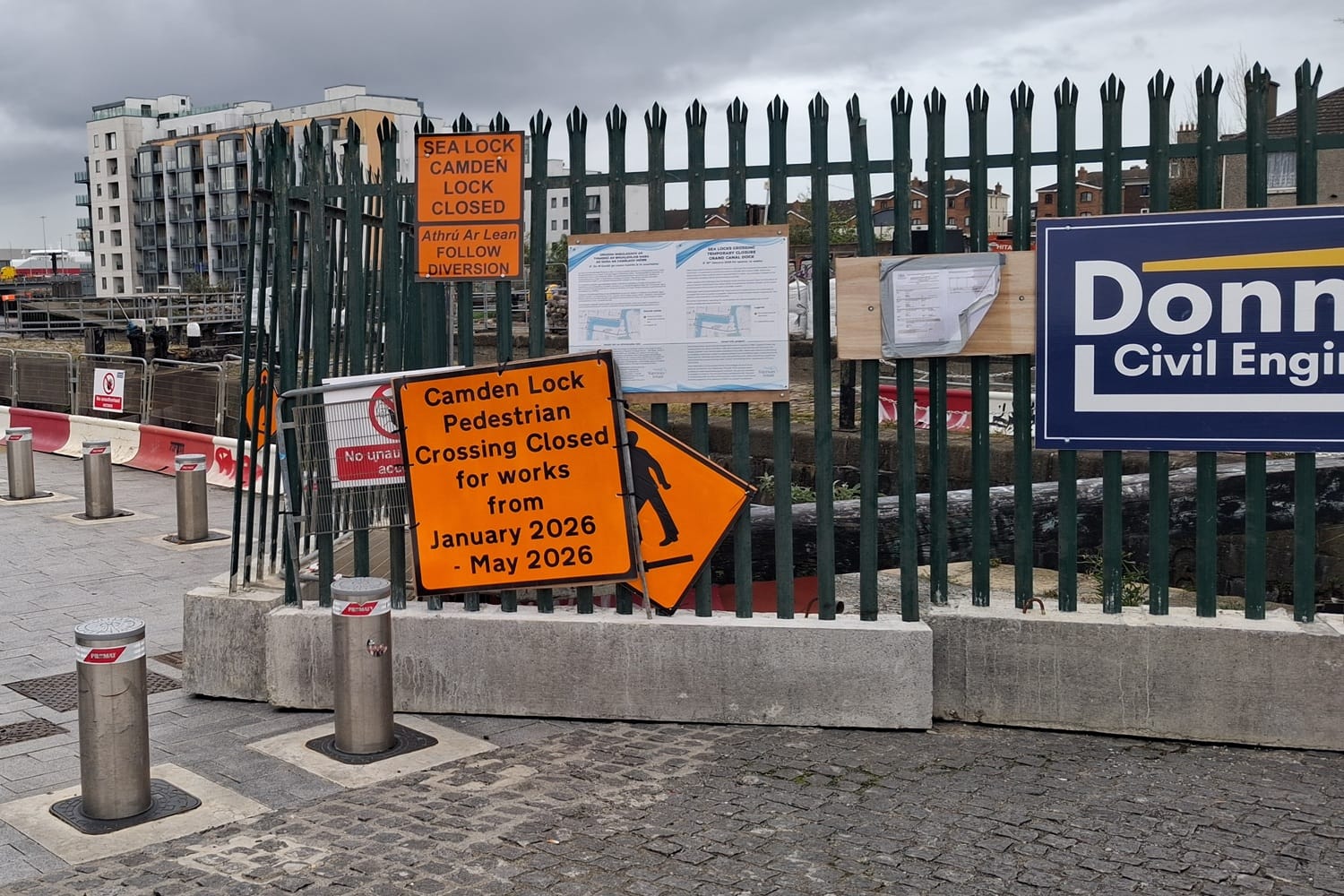
The Thursday after the AGM, the sea locks next to the graving docks were entirely fenced off. Locals were unable to cross over the lock bridge to enter Ringsend.
The Camden Lock Pedestrian Crossing was closed for works from January 2026 to May 2026, read an orange sign fixed to green fences, which were held down by long concrete blocks.
Photo by Michael Lanigan.
The three sea locks, which connect the canal to the Liffey, are being restored, a notice nearby said.
This is intended to re-open the Grand Canal Dock to tall ships and other large sea-faring crafts, it said, “while maintaining, preserving and protecting a unique heritage asset”.
Below one of these notices promising to bring about a new "renaissance", somebody had tagged one of the concrete blocks with the words “load of bollox” in black spray paint.
The area around the graving dockswill be a working site for the next 18 months, Ingle told the AGM.
But, the graving docks themselves will remain in public ownership, nor will they be built over, he said.
Instead, the dry dock will become a functional space for repairing boats, Ingle said. “So the people who are on the liveaboards over there, on the barges, are gonna be able to have a place to go and do their repairs on their boats that they need to do.”
A spokesperson for the Grand Canal Dock Marina Residents Working Group, when asked for comment, provided a report that says barges require drydocking every two to three years to clean and paint their hulls, to check for rust and to change the anodes which protect underwater metals from corrosion.
The nearest dry docks for Dublin-region barges are in Athy and Mullingar – which are about five days away by barge – and Shannon Harbour in Offaly, a seven-day journey, the report says.
There are approximately 35 barges in the Grand Canal Dock, and 165 more throughout the Dublin-Kildare area, it says. “When a barge goes into dry dock, it takes five to seven days to complete maintenance.”
A functional graving dock would create a vibrant hub of activity, it says. “It would also be a logical solution to a huge problem that over 200 boaters face every three years.”