

Father of disabled child refused access to a disabled car parking spot in his complex
He has a blue badge, he has offered to pay, but as a social tenant, he is shut out.
The Department of Transport says it’s working on a home-charging solution for those who don’t have driveways.

In Kilcarbery Grange near Clondalkin, residents have been told they must remove electric car chargers from the footpaths outside their homes – after spending around €2,000 each to have them installed.
The estate generally consists of terraces of two-storey townhouses, with small front gardens that abut the footpath and, on the other side of that, parking spaces.
Subhash Mathew drives a hybrid, plug-in electric car. There is a parking spot right outside his house, but like most in his estate, it's a communal space – it’s not reserved for him alone, he said.
At first, Mathew used public charging spaces that are provided within the estate, he said. But those are also outside people’s houses, so that caused conflict with those people, who also wanted to park in front of their own houses.
So Mathew shelled out around €2,000 for a company to install a charger on the footpath outside his home.
The cable goes under the footpath, not causing any hazard, he says. “There is no cable outside, there is no issue,” said Mathew, “everything is 100 percent safe.”
In February though, residents got an email from the estate owners’ management company. On-street chargers are not allowed and must be removed before South Dublin County Council can take charge of the estate, it said.
In many estates, the developer initially builds not only the homes but also the common areas such as roads, footpaths, green areas, and more.
There is then, later, a “taking-in-charge” process, through which the council takes over responsibility to maintain those common areas.
South Dublin County Council “fully supports the transition to more sustainable transport choices and recognises the increasing uptake of electric vehicles”, a council spokesperson said.
But “where privately installed EV chargers remain within footpaths or communal parking areas, the Council cannot assume responsibility for the road, footpath or associated services”, she says.
Hence the pressure on residents to remove their EV chargers.
Meanwhile, the Department of Transport and the Department of the Environment said in a joint statement that they are working together “to develop a solution to enable people without access to off-street parking to use a home charging solution for on-street parking”.
However, that doesn’t necessarily mean these personal on-street chargers will be allowed in the future.
A spokesperson for South Dublin County Council says the new draft legislation “makes clear that such infrastructure must be delivered through planned, regulated and coordinated solutions, subject to appropriate standards, permissions and oversight, rather than through ad-hoc individual installations in shared public spaces”.
Sinn Féin local representative Derren Ó Brádaigh says there is widespread confusion about the issue among residents of multiple estates in South Dublin. “There needs to be more clarity in plain and simple language for the public,” he says.
On Wednesday afternoon, around 3pm, Azeez Jimmy stood outside his house on Rowan Avenue in Kilkarbery Grange.
His taxi was parked in front of his house, in a space across the footpath from his front door. At the head of the spot was a Zappi EV charger, which he says he had installed for about €2,000.
Since taxi drivers cover a lot of ground, their shift to electric cars plays an important contribution towards slashing carbon emissions.
Jimmy said he needs to charge his car every day. When he moved into Kilcarbery Grange, the planned public charging stations were not yet up and running, which pushed him to get his own charger, he says.
Also, the public charging stations were in spots in front of other people's houses, he says – echoing Mathew – and that could cause conflict if the person who lived there wanted to use that spot.
“The ones provided by management are right in front of people's houses – they're expensive, and there will be arguments, fighting,” Jimmy said.
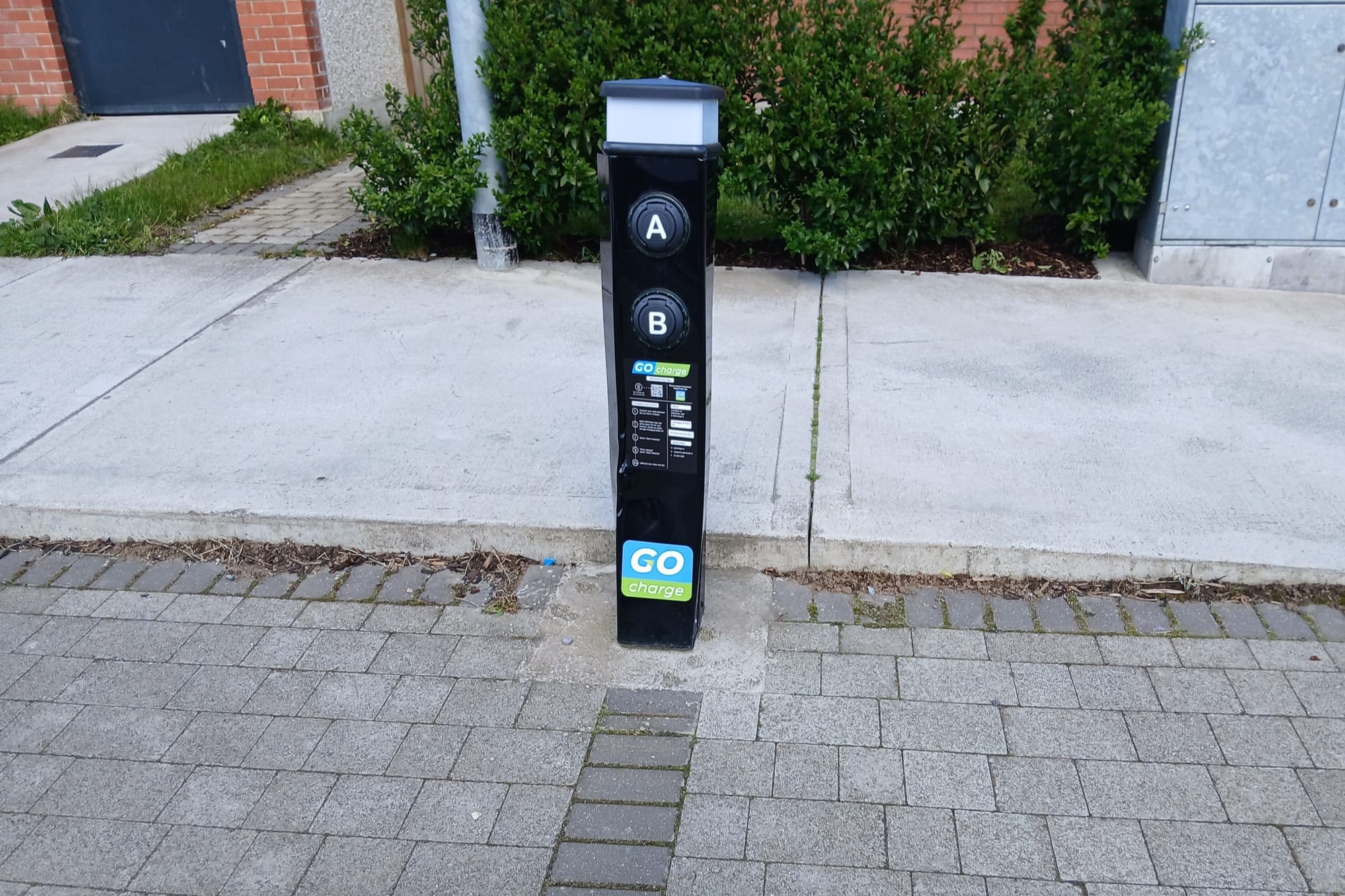
Not only that, but the public/commercial chargers in the estate are about four times more expensive than the charger he has installed, he said.
The public chargers cost around 60 cents per kilowatt-hour, while charging at a private charger costs 10 cents to 16 cents an hour, he said.
Mathew, the other resident, said that when he parked outside someone else’s house in a public charging station, his car was vandalised.
There are also not enough of the public chargers for the number of people who need to charge their cars, said Mathew.
Multiple householders in Kilcarbery Grange have installed electric chargers themselves, in communal spots outside their homes.
Many new housing schemes, including another massive development nearby at Seven Mills, have communal parking. But communal spots don’t work well with electric charging, Mathew said.
Most houses have a parking spot outside, Mathew said, so if each had a space assigned, there would be fewer problems. “We’re still asking for assigned spaces for each house.”
He doesn’t always get to park outside his house, but he said that is not a major issue. “When they remove the car, I will put it back, no issue.” At least most of the time, he can charge cheaply and easily in front of his own home.
People have paid around €500,000 to €550,000 to buy their homes, said Mathew, and he thinks each home should have one designated parking space.
Residents have contacted all the local politicians, but “we still don’t have any green signal”, he said.
Communal parking aims to reduce car dependency, said the spokesperson for South Dublin County Council. These schemes were designed before the widespread use of electric cars, she said.
By late 2010, the Irish government had set a target for 10 percent of all vehicles – 225,000 vehicles – to be powered by electricity by 2020.
The developer Adwood lodged a pre-planning application for Kilcarbery Grange in 2018 and got planning permission for it in late 2019.
By 2024, about 4.5 percent of passenger cars in Ireland were EVs, according to the European Alternative Fuels Observatory. The Irish government’s goal is to raise that to 30 percent by 2030.
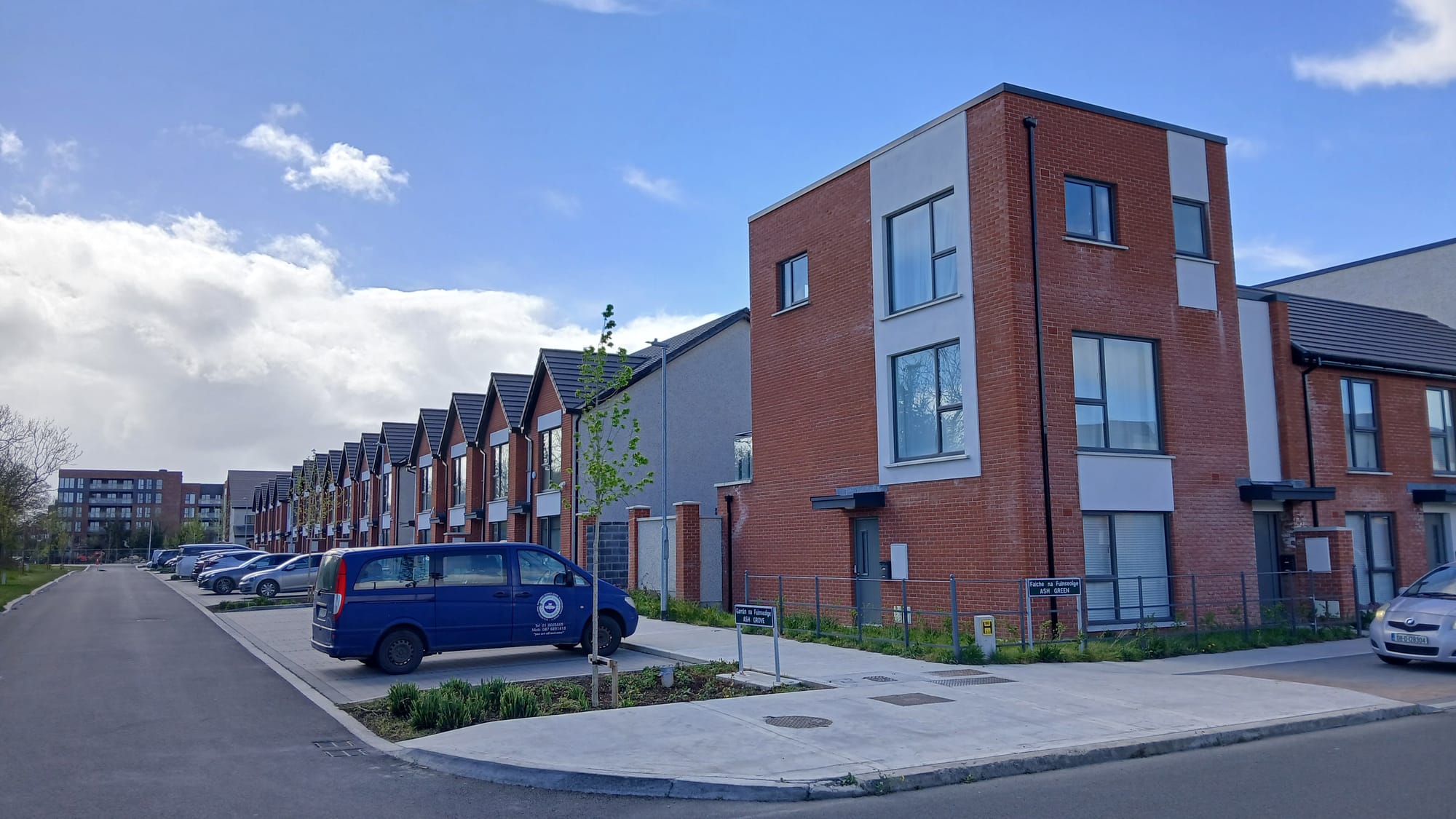
Councils need to review the preference for communal parking layouts, Ó Brádaigh said. But even for householders who have a designated parking spot, there is currently no process to apply for permission to install an electric charger space on-street, he said.
The issue is popping up across estates, and the council tells people to use communal chargers. “The public charging infrastructure is wholly inadequate,” he says. It's unreliable, too slow, too expensive, and there are not enough charging stations in the area, he says.
If big planned new housing estates are forced to use communal chargers only, there would be queues, Ó Brádaigh said, which could in turn discourage people from transitioning from fossil fuels.
Mathew, the Kilcarbery Grange resident, said he is confused as to whether government policy is in support of people switching to electric cars. If it is difficult to charge, fewer people will make the shift, he said.
The estate management company told residents to remove the chargers by email in February 2026.
“Any chargers installed on OMC-managed areas or areas controlled by SDCC (South Dublin County Council) will be removed in the coming weeks,” the email said. “This is to make sure that these areas can be properly handed over to SDCC.”
It is not clear whether residents like these will be allowed to install chargers on the footpaths outside their homes in the future.
The joint statement from the Department of Transport and the Department of the Environment says that it is working on “a solution to enable people without access to off-street parking to use a home charging solution for on-street parking”.
“The Department of Transport expect to have this finalised later this year,” a spokesperson said.
Cabinet has approved the private wires general scheme, he said, and pre-legislative scrutiny took place in February. The Department intends to enact the new laws by the end of 2026, says the spokesperson.
“Private lines will be allowed where they are the solution to allow on-street charging of electric vehicles,” says a summary of the draft private wires bill 2025, on the Department of Environment’s website.
A spokesperson for the Department of Housing said it's a decision for councillors. The chargers don’t require planning permission, and it's up to the council to decide whether to allow this, he says.
Taking charge of a road “is a reserved function of the elected members”, he said. “Charging points are exempt from the need for planning permission, so it is a matter for the land owner.”
A council spokesperson said that: “Privately owned electrical equipment in the public realm presents operational, safety and liability challenges, including potential obstruction of footpaths, accessibility impacts for other users, and interference with underground services.”
There is a risk of setting an unsustainable precedent, she said, which could lead to “the uncontrolled proliferation of other private installations within shared public spaces”, says the spokesperson.
She acknowledged the government’s policy calling for electric charging, including on-street solutions in higher-density developments.
Still through, such infrastructure must be coordinated, the spokesperson said. “Subject to appropriate standards, permissions and oversight, rather than through ad-hoc individual installations in shared public spaces.”