

Is a bad definition of "derelict" partly behind the bad dereliction in Dublin?
The Department of Finance, with Revenue and the Department of Housing, is looking at a new definition, said a spokesperson.
Changes to improve safety are part of the planning permission, while a walkability audit five years back made recommendations, too.

Francesco Pilla has lost track of how many times he has seen cars fly through red lights and over the pedestrian crossing at the junction near Harold’s Cross Educate Together National School, as he brings his children to and from the campus.
“It’s something that happens every single morning,” he said by phone on Wednesday.
Recently, he was frightened out of his skin, he said, when a van sped through the crossing, which had a green man, and narrowly missed his child on a scooter.
“Sometimes, my little son, when he sees the green man, he flies straight on,” he says.
Pilla speaks as both a concerned parent, and an academic.
In his role as professor of smart and sustainable cities at the School of Architecture, Planning and Environmental Policy in UCD, his work focuses on building better and safer communities, he said.
Last year, Pilla organised a project that saw student’s scooters fitted with cameras, so they could document the chaotic traffic around the school and the nearby junction, as they navigated it.
“We captured many vans, cars passing through the red light, skimming the kids passing through the red light with a full green man,” he says.
Chaos at that junction of Harold’s Cross Road and Parkview Avenue is just one of several concerns members of the school’s parent staff association (PSA) have, they say.
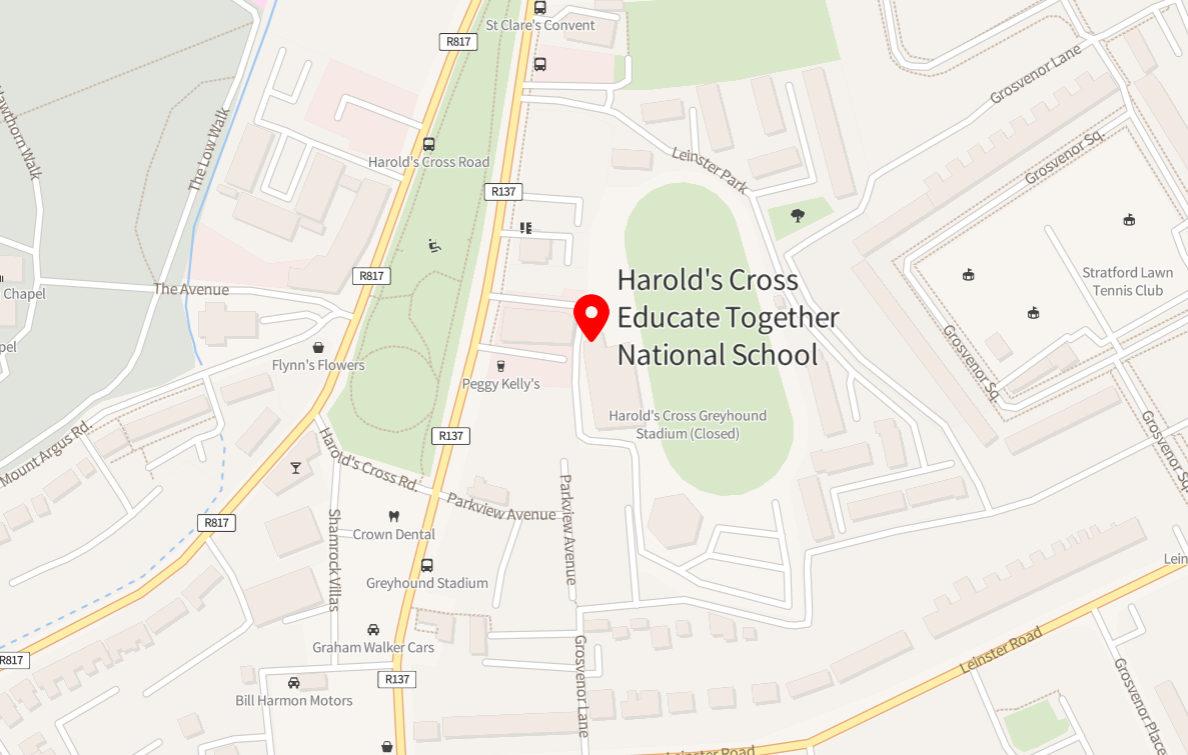
Concerns for the traffic around the campus, a former greyhound racing stadium, were flagged before the school welcomed its first tranche of students, junior infants, in 2019.
At the time, it was a temporary set-up, with lessons run in makeshift classrooms.
In March 2022, permission was granted for the demolition of existing buildings on the site and the construction of the new school.
Now, the developed campus is up and running with 177 students in the junior school.
That number will rise to 400 in the coming years as the junior school becomes dual stream and reaches its capacity, says Gordon Cummins of the parent staff association.
It will also rise later this year as the senior school on the same site move into their new building, he says.
Ahead of construction of the permanent school, in 2021, a walkability audit of the area around the campus made a series of recommendations on how to make getting to and from the school safer for kids.
Frustratingly, says Cummins, a lot of those recommendations have, so far, remained ignored.
“The school is open, but the infrastructure around it hasn't been upgraded to allow for the fact there's actually a school entrance right there,” he says.
A spokesperson for the Department of Education said that campus development is being rolled out in phases under a design-and-build contract.
It will be delivered in line with its planning permission, they said, “which includes conditions relating to improvements to the local roads network in consultation with the National Transport Authority and Dublin City Council".
The school didn’t suddenly appear out of the ground unexpectedly, says Cummins.
Indeed, Dublin City Council rezoned the site in September 2017 in expectation of the school being built.
From the get-go, says Cummins, the school was envisioned as a car-free campus – something, he says, everyone understood and supported.
Dublin City Council’s planner’s report shows that zero car parking spaces were to be included. That includes for staff, Cummins says.
In a 2018 submission to the planning process, the National Transport Authority (NTA) said it “strongly supported” this approach.
It also recommended “a programme of works would be developed to ensure that adequate pedestrian crossings were provided at junctions within the catchment of the fully built-out schools”.
“The NTA welcomes the fact that these have been identified in the material submitted with this application,” it said.
“As such, the NTA supports the proposed development as an example of how schools could operate in central suburbs in a manner which emphasises walking and cycling as modes of transport,” it said.
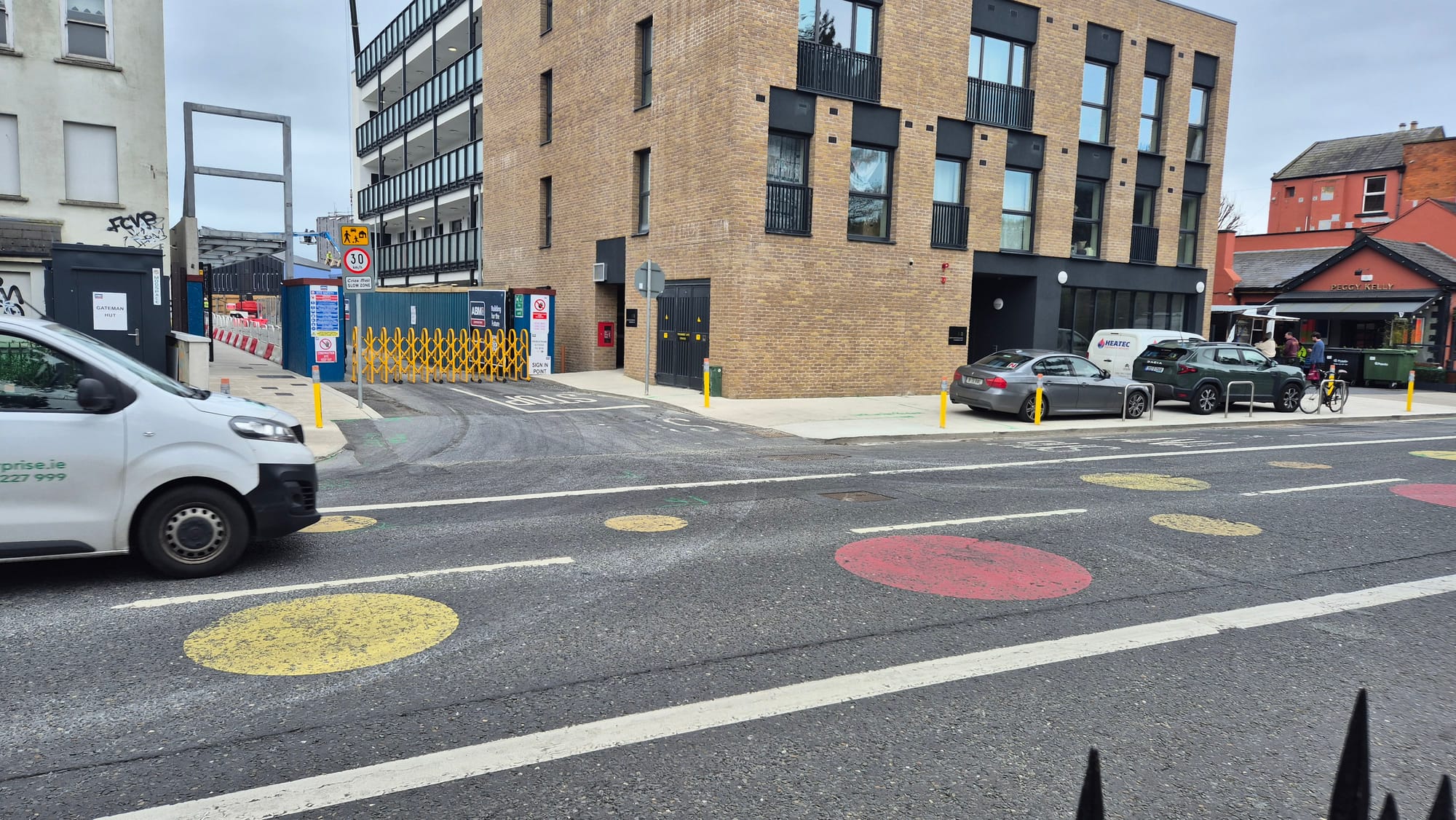
The walkability audit’s recommendations, as acknowledged in council’s planner’s report, lead with a suggestion that a crossing be installed from the school entrance, over Harold’s Cross Road, to Harold’s Cross Park.
But, five years on from the audit, this hasn’t been done – and neither have other recommendations to make it safer for kids to get to the school.
Currently, there is a footpath along the side of Harold’s Cross Road where the school is, but none on the far side. Over there, the road simply meets the park’s fence.
This causes heavy pedestrian, bike and scooter use on the school side.
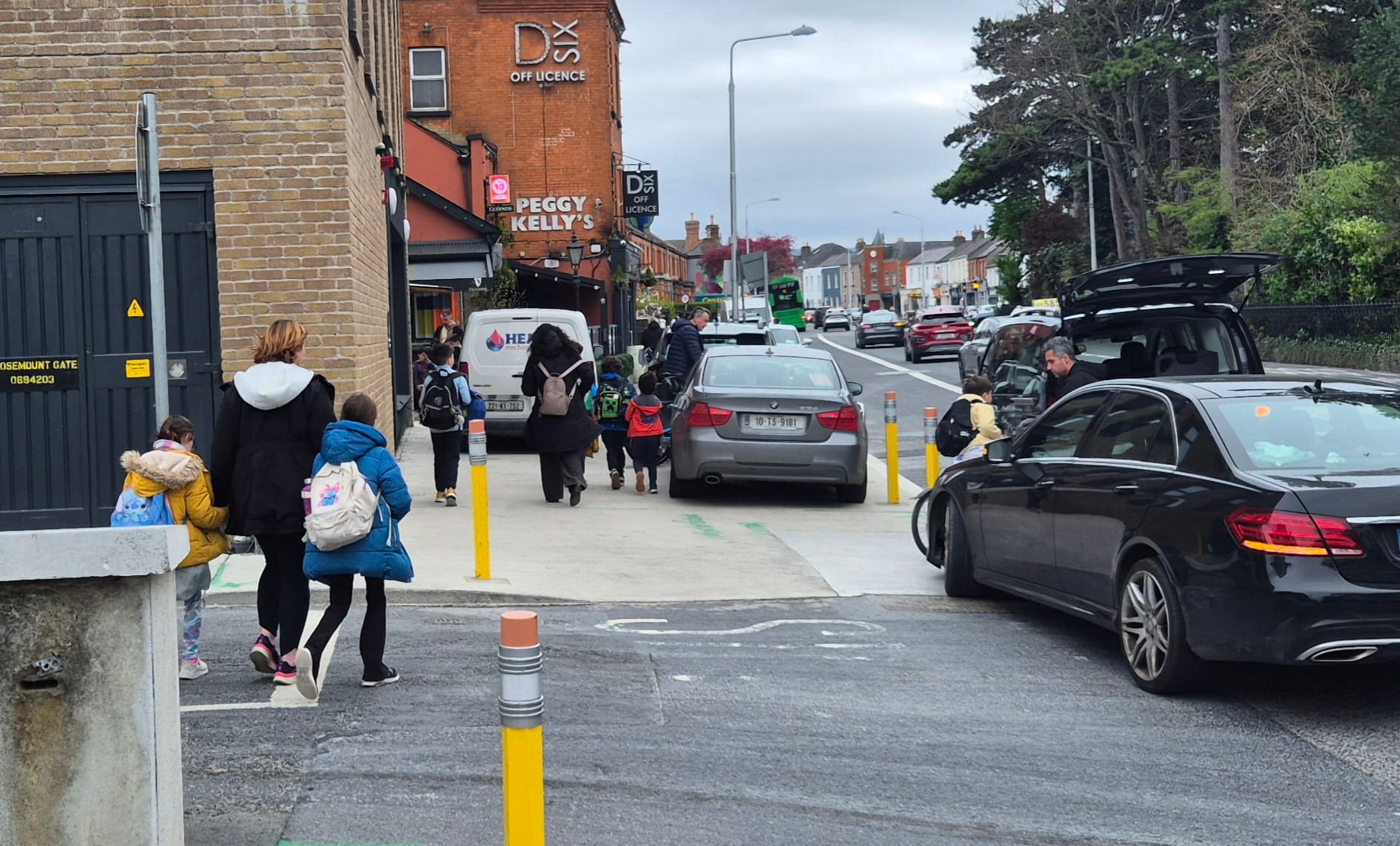
Clogging it up even more, people use a section of the path, in front of the apartment block by the school’s entrance, as parking, illegally, Cummins said.
There were yellow school-zone pencils blocking vehicles from that section of path, but one pencil was removed to allow emergency services for the apartments to park there, if need be, he says.
Now, people drive through that gap and park there in their threes and fours, he says. “It’s havoc at drop-off and pick-up.”
The 2021 walkability audit’s first recommendation is to investigate the provision of a pedestrian crossing, directly linking the park to the school.
That way, people could walk to the school on both sides of Harold’s Cross Road. And they could come from bus stops on Kimmage Road Lower, through the park, to the school, the audit says.
“There is a disused gate to the park directly opposite the schools’ access road,” it says. “A footpath would be required to be provided along the west side of Harold's Cross Road, fronting the Park.”
A school warden could be provided before and after school, it says.
The school is now well up and running, but there is no mention of sorting that crossing from the school to the park, Cummins says.
There is also a secondary entrance into the school grounds from Grosvenor Lane, on the opposite side of the campus from the main entrance on Harold’s Cross Road.
The walkability audit recommendations also mentions Grosvenor Lane, where additional signage and traffic management measures are needed, it says, to address potential conflicts between vehicles on the lane and increased pedestrian use from new school access points.
The recommendations also highlight the need for clearer arrangements within the school itself, including how internal roads will operate and measures to prevent clashes between pedestrians and vehicles near turning areas.
To the best of Cummins and the PSA’s knowledge, he says, few of the audit’s recommendations have been actioned.
A spokesperson for the Department of Education said on Thursday that the works it has committed to undertaking, as agreed under the final planning permission conditions, include the installation of two signs on Grosvenor Lane.
Also, the “tactile paving, drop kerbs and concrete footpath reinstatements at the Parkview Avenue / Harold’s Cross Road junction”, they said.
The installation of a permanent controlled crossing at the junction of Leinster Road and Harold’s Cross Road – further south from the highly problematic Parkview Avenue junction – is also stated as a necessary work by the Department of Education. That one is currently underway.
Recent school travel surveys have been carried out, said the spokesperson, with the results due to be forwarded to the local authority.
Any consideration for the walkability audit’s popular recommendation for a crossing between the park and school entrance seem to have evaporated, says Pilla.
People have also been calling for a yellow box at the main school entrance, says Pilla, professor of smart and sustainable cities at the School of Architecture, Planning and Environmental Policy in UCD – and a concerned parent of the school.
When people cycle to school along Harold’s Cross Road from the south, it’s extremely dangerous for them to turn across oncoming traffic into the school gates, Pilla said.
There’s a constant flow of bumper-to-bumper traffic in the morning, he says.
On the parent staff association’s incident log, one parent recently called out that same issue.
“Outside the school gates. Turning right on a bicycle on Harolds Cross Road at dropoff. There's very poor visibility due to have to cross between two lanes of traffic as no 'yellow box' or crossing point outside the school.
“This morning a taxi came up the bus lane at speed causing a near miss right outside the school gates. Improvement works are badly needed,” it says.
Although, Pilla says, he isn’t confident that a yellow box alone would make much difference either.
“If a driver has no issue breaking a red light, I don’t think they’ll pay attention to a yellow box,” he says. “Especially if there is no garda there monitoring.”
Curiously, condition no. 2 of the planning permission identifies certain improvements to the local road networks which must be carried out “prior to the first occupation of the school campus”.
The reason? “In the interest of safety,” it says.
Accompanying drawings of the necessary works show a cycle lane running along Harold’s Cross Road, past the school’s entrance, another cycle lane running along the park’s perimeter opposite the school, and a yellow box at the school entrance’s mouth.
These have not been sorted, yet children occupy the campus.
A letter from the parent staff association to Dublin City Council, councillors, and TDs says they have been repeatedly referred to the School Zone scheme, which is designed to reduce parking at school gates.
“However, parking at school gates is already impossible and therefore this scheme does not address our most pressing concerns,” the letter says. “The core issue is not parking behaviour, but the absence of adequate pedestrian infrastructure and supervision at dangerous junctions.”
The letter also highlights four dangerous junctions that kids coming from the south must navigate.
Crossing Leinster Road on Harold’s Cross Road. “A busy intersection with no pedestrian crossing, blind corners and unpredictable traffic from multiple directions,” says the letter.
A pedestrian crossing is currently being built there.
Also, crossing from the south-east exit of Harold’s Cross Park. “A heavily used junction with significant vehicle traffic entering and exiting near the school,” it explains.
Says Cummins, a zebra crossing has been promised there later in the year.
While it would be a positive, he says, similar to Pilla’s views on a yellow box outside the school, he isn’t sure cars will pay it much heed.
Also flagged in the PSA’s letter is the pedestrian crossing on Harold’s Cross Road towards Parkview Avenue.
“Although traffic lights are in place, poor signage and design leads drivers to frequently proceed through the crossing when the pedestrian light is green, and electric bikes and scooters regularly ignore the signals,” it says.
Finally, it mentions crossing Parkview Avenue: “A junction with blind corners and no adequate pedestrian protection or road markings.”
Another no-brainer, says Cummins, is for a school warden – a lollipop person – to be on duty at key times at the dangerous junction of Harold’s Cross Road and Parkview Avenue.
There is still no sign of one being provided, however, he says.
In response to a Freedom of Information request, the PSA received Dublin City Council’s guidelines for allocating school wardens.
The council conducts a site check, over a two-day period, the guidelines say.
Sites having less than 15 unaccompanied children crossing the road in the busiest 30-minute period should not be considered for a school warden crossing point, the guidelines continue.
Cummins says this is baffling logic, certainly in the case of Harold’s Cross Educate Together National School.
The catch-22, he says, is that no parent is going to let their child cross the road because it is so unsafe, he says.
“They can observe it every single day for the next week if they want, and they won't get their 15 kids because nobody is going to let their kid cross the road,” says Cummins.
Things are so bad near the school that the parent staff association has teamed up with a local business who have allowed them to install a camera on their premises, to record the junction at busy times, he says.
It uses specialised software that makes sure the faces are blurred out, for GDPR, he says. “There's been many hoops that we've had to go through.”
But ultimately, he says, this is how serious things are. “If there is an accident, we will have camera footage of it.”
Pilla, the parent and UCD academic, is also baffled that a traffic warden has not yet materialised.
“It's not rocket science. It's not that we are asking for some crazy technology or something that is going to cost millions to deploy,” he says.
That the concerns of parents, staff and children seemingly continue to fall on deaf ears is beyond frustrating, says Pilla. “There is no moving forward.”
Funded by the Local Democracy Reporting Scheme.

“How are kids meant to walk to a playground if it’s cut off?” asks Robert Kelly, the chairperson of the Lougshinny Community Association.

He has a blue badge, he has offered to pay, but as a social tenant, he is shut out.

So goes Michael J. Hartnett’s new play, which had a rehearsal reading this week at the Five Lamps Arts Festival.

A scaled-down version is being looked at, said council Chief Executive Richard Shakespeare on Monday.