The company's application includes preliminary results of its assessments of the environmental impacts of raising the cap from 32 million to 40 million passengers per year.
The roll-out of renewable energy generation is needs to be accelerated to hit Climate Action Plan targets, according to a report from the Climate Change Advisory Council.
Longtime city clampers DSPS, after losing a competition for the council's new contract to rival APCOA, had challenged that decision in court. It's not over yet.
Now that he can do it, DAA has formally written to the minister asking him to lift the Dublin Airport passenger cap
The company's application includes preliminary results of its assessments of the environmental impacts of raising the cap from 32 million to 40 million passengers per year.
Now that Minister for Transport Darragh O'Brien has the power, DAA – the company that runs Dublin Airport – has written to him asking him to lift the passenger cap from 32 million people per annum to 40mppa.
And the minister could also choose, under a new law passed in July, to "vary" what DAA has requested – and rather than raise it, eliminate the cap entirely.
"If the Minister decides to vary daa's proposal to revoke the passenger capacity conditions, daa would be delighted to provide any information requested by the Minister", says the 5 August letter, from the airport's deputy chief executive, Nicholas Cole.
There has – in theory, if not in practice – for years been a cap of 32 mppa on the number of passengers who can travel to and from the airport. It was a condition of the planning permissions for the two airport terminals, granted in 2007 and 2008.
Now, bear in mind that DAA could actually have applied for planning permission at any time to amend or remove that cap, said Gareth O'Brien, who lives in flyover country in Ashbourne.
"Given 17 years to do that, DAA has singularly failed," says O'Brien, who is also a member of the North Runway Technical Group, a voluntary group of aviation professionals set up to act as a watchdog for how DAA has been operating since it opened its northern runway.
But DAA waited until December 2023 to apply to Fingal County Council, at which point it asked for planning permission to expand the airport's infrastructure to handle 40 mppa and to permit that number. The council hasn't yet decided on that application.
So, under pressure from airlines that want to run more flights into and out of the airport, the minister has stepped up with legislation on demand, said Gareth O'Brien, to allow himself the power to remove the planning condition that says, simply, make a planning application.
DAA's application to the minister says that the cap now needs to be lifted urgently because of a pending judgment in the Court of Justice of the European Union (CJEU).
That ruling is likely to say that the Irish Aviation Authority (IAA) is required to take the passenger cap into account, when it allocates flight slots for airlines – which it had been blocked from doing, by the lawsuit. That change would mean 4.4 mppa fewer passengers allowed to travel this year, compared to the number who travelled in 2025.
A spokesperson for the Department of Transport said on Thursday afternoon that the application from DAA is being considered.
Before the minister can issue any order, though, An Coimisiún Pleanála has to carry out independent environmental assessments, in line with EU Law, said the spokesperson. "The Minister is required to consider the outcome of those assessments when making an Order."
The process and any consultation from here is important, said Green Party TD Roderic O'Gorman. "Throughout the whole process, there was a lot of ... commitments to residents that their concerns about noise in particular would be taken into account during this new process."
"Now we'll see whether this actually happens," he said.
Whatever happens now though, with the minister's order, under this new legislation – if Fingal eventually approves DAA's infrastructure application, that'll take precedence, says Gareth O'Brien, of the North Runway Technical Group.
The act prohibits the planning authority, which is Fingal, and An Coimisiún Pleanála from setting any passenger cap for Dublin Airport going forward – but carves out an exception when it comes to that live planning application.
What was it for?
Government and aviation bodies have given different reasons as to why the cap of 32 million passengers came in two decades ago, emphasising that it wasn't brought in an a climate measure.
"It was to address local traffic impact primarily," said Miriam Ryan, DAA's chief governance and strategy officer, before the the Oireachtas Joint Committee on Transport in March.
Declan Fitzpatrick, chief executive of the Irish Aviation Authority, said that the figure had flowed from the council's local area plan (LAP) in place at the time.
That envisaged a third terminal on the western end of the airport, he said, and the idea was that terminals 1 and 2 on the east side of the airport should cater for a maximum of 32 million passengers.
"So that there would be sufficient future passengers to use this terminal 3 and, thus, the airport would develop in the manner envisaged in the 2006 LAP, with balanced development on the east and west sides," he said.
But even if it wasn't brought in as a measure to combat climate change by limiting carbon emissions, the original intent is irrelevant, said Jerry McEvilly, of Friends of the Earth, at a later hearing of the same committee.
"The passenger cap functions as a de facto mitigation measure," McEvilly said. "Any removal would require the Government to implement equivalent alternative actions to reduce emissions."
In reality, the cap has pretty much been on paper only, said Gareth O'Brien, of the North Runway Technical Group. "The passenger cap has never restricted the capacity of Dublin Airport."
Indeed, despite the 32 mppa cap, there were 33.5 mppa passengers in 2023, about 34.6 mppa in 2024 and 36.4 mppa in 2025, according to DAA's application to the minister. And, it's currently subject to a High Court stay.
In its application this month, DAA stressed the urgent need for speed in lifting the passenger cap.
If the CJEU rules that the cap has to be taken into account, that risks "significant economic and social harm" with "substantial foregone employment and Gross Value Added, together with adverse impacts on tourism, connectivity and national competitiveness", its application says.
As Gareth O'Brien sees it, "They're trying to prevent the court from ruling". If the Minister activates the legislation, they can run back to the High Court and say they can call off the CJEU case, he said.
The ruling in that case would have a much broader impact, he said. "It would basically give a voice to communities all over Europe who are affected by aircraft noise," he said.
Because it would say that a local planning restriction is a "legitimate constraint" when it comes time for the slot authorities to calculate and dole out the slots, he said – it would be a green light for them to take those planning restrictions into account.
Assessing the environmental impact
The new Dublin Airport (Passenger Capacity) Act 2026 lays out the process that kicks in, now that DAA has made its application to the minister.
Now that DAA has applied, the Minister for Transport, Darragh O'Brien, should consider that, and let DAA know whether he intends to do.
Then the minister "may direct" DAA to provide a bunch of environmental reports, "for the purposes of carrying out an environmental impact assessment".
The act provides for a period of public consultation on those reports, and it'd be An Coimisiún Pleanála (ACP) that would carry out any environmental impact assessment – and the minister can't issue any order before that assessment is done, it says.
In its application, DAA argues that a full environmental impact assessment by ACP isn't actually needed, because the issue in play is changing the passenger cap rather than any physical construction.
Still, though, DAA has been working on an Environmental Impact Assessment Report (EIAR), Natura Impact Statement, and Water Framework Directive Assessment, and they are well advanced, it says.
They compare for the most part, it says, a "do nothing" scenario with a passenger cap of 32 mppa still in place with the impact of a "do something" scenario with the 40 mppa cap in place, the application says.
DAA hasn't addressed a query sent Thursday asking whether the "do nothing" baseline is based on the real situation, with the 32 mppa cap in place but being breached, or a scenario in which DAA is complying with the cap.
While these assessments have to be finalised, there are already key findings, the DAA's application says. Based on the work so far, "no likely significant residual environmental effects have been identified", it says.
"Across the remaining environmental topics, effects are either not significant or can be appropriately managed through existing operational measures, airport infrastructure, environmental-management procedures and statutory regulatory controls," it says.
Despite DAA's caveated position, Sorcha Tunney, senior manager at the environmental NGO Opportunity Green, said that its view is that an EIA is required, under the EU directive.
"This obligation applies regardless of the absence of new building or construction works. The Directive is explicit on this point," she said.
She pointed to Annex II, paragraph 13(a), which captures "any change or extension of projects listed in Annex I or this Annex, already authorised, executed or in the process of being executed, which may have significant adverse effects on the environment".
Getting there and back
As part of this whole process, DAA has been working on a Traffic and Transport Assessment looking at how an increase to 40 mppa would affect the surrounding transport network – big roads such as the R132, M1 and M50, as well as the junctions around the airport.
It indicates so far that "the proposed order will not give rise to likely significant operational effects on the external strategic or local road networks, or on the internal road network". Effects are localised to the "airport surface access network" it says, and are "direct, long-term and reversible".
"A moderate negative operational effect" is forecast at the evening peak hour for traffic exiting the airport at the Airport Roundabout, and a slightly negative effect for traffic entering the roundabout from the M1 link during the morning peak.
Also, a moderate negative operational effect is also forecast at the Ground Transportation Centre, DAA says. That's where the buses and taxis do pick ups and drop-offs.
Impacts can be "accommodated through the existing and committed transport network" and there's already monitoring of transport and key performance indicators (KPIs) to meet under its "Surface Access Monitoring Framework", it says.
One of the KPIs that isn't currently being met is for staff travel, it says.
So, they will aim for "mitigation measures" to target staff travel demand, which may include more remote working, staff parking restrictions during peak periods, variable tariffs for staff parking, and incentives to encourage a shift from private cars to public transport.
Air, water and carbon emissions
When it put out its May report on the bill to remove the passenger cap, then still a draft, TDs on the Joint Oireachtas Committee for Transport flagged slight unease about the independence of environmental assessments.
"The Committee noted that officials confirmed data for environmental assessments under the Bill will be collected by the daa and provided through the Minister to An Coimisiún Pleanála. Members expressed concern regarding the absence of independent data collection given the daa's role as the subject of those assessments," said their final report.
DAA's application gives a window into how the environmental assessments that it has commissioned are are going so far.
Forair quality, DAA's assessment looks at the potential effects "from changes to emissions associated with airport operations", the application says.
The proposed order "would result in no significant effects on air quality or odour", it says. "Against current National Air Quality Standards, impacts range from neutral to slight adverse and are not significant," it says.
Against the new EU Air Quality Directive values, "moderate to substantial adverse impacts are predicted at a limited number to receptors close to the airport for annual mean NO2".
But, taking into account the "limited spatial extent, precautionary modelling assumptions and projected improvements in emissions over time, the overall effect is concluded to be not significant", it says.
Electrification projects, and reduced emissions from the airport's energy centres will reduce emissions, it says.
For the water quality, the assessment so far indicates that the "proposed order is not likely to give rise to significant residual effects on the water environment".
Effects on surface water and groundwater have been assessed as "localised, long-term and of negligible magnitude, with no deterioration in water body status predicted", it says.
For biodiversity, increasing the cap "is not likely to give rise to significant effects on biodiversity at County or greater geographical scales", it says. Operational effects are predicted to be "localised, long-term and of negligible magnitude", it says.
For climate, it looks at potential affects arising from greenhouse gas emissions associated with airport operations – and resilience of airport operations to future climate change.
The assessment so far indicates that "the greenhouse gas emissions associated with the proposed order are compatible with the relevant emissions trajectories and remain consistent with applicable carbon budgets", and is consistent with national and international climate policy.
It takes into account the carbon-reduction measures the airport has in place, and its carbon reduction strategy. And, it has regard to assumptions about aircraft fleet modernisation, and sustainable aviation fuel uptake.
No additional mitigation, monitoring, or control measures are needed, it says.
Noise
Standing in front of a small house on the R121 in Shallon, on Monday, about 2.5km north-west of Dublin Airport's runways, Pat Farnham said he didn't really have a problem with plans for a vast solar farm next door.
"The planes are much worse," said Farnham, who said he'd live in the area for 50 years.
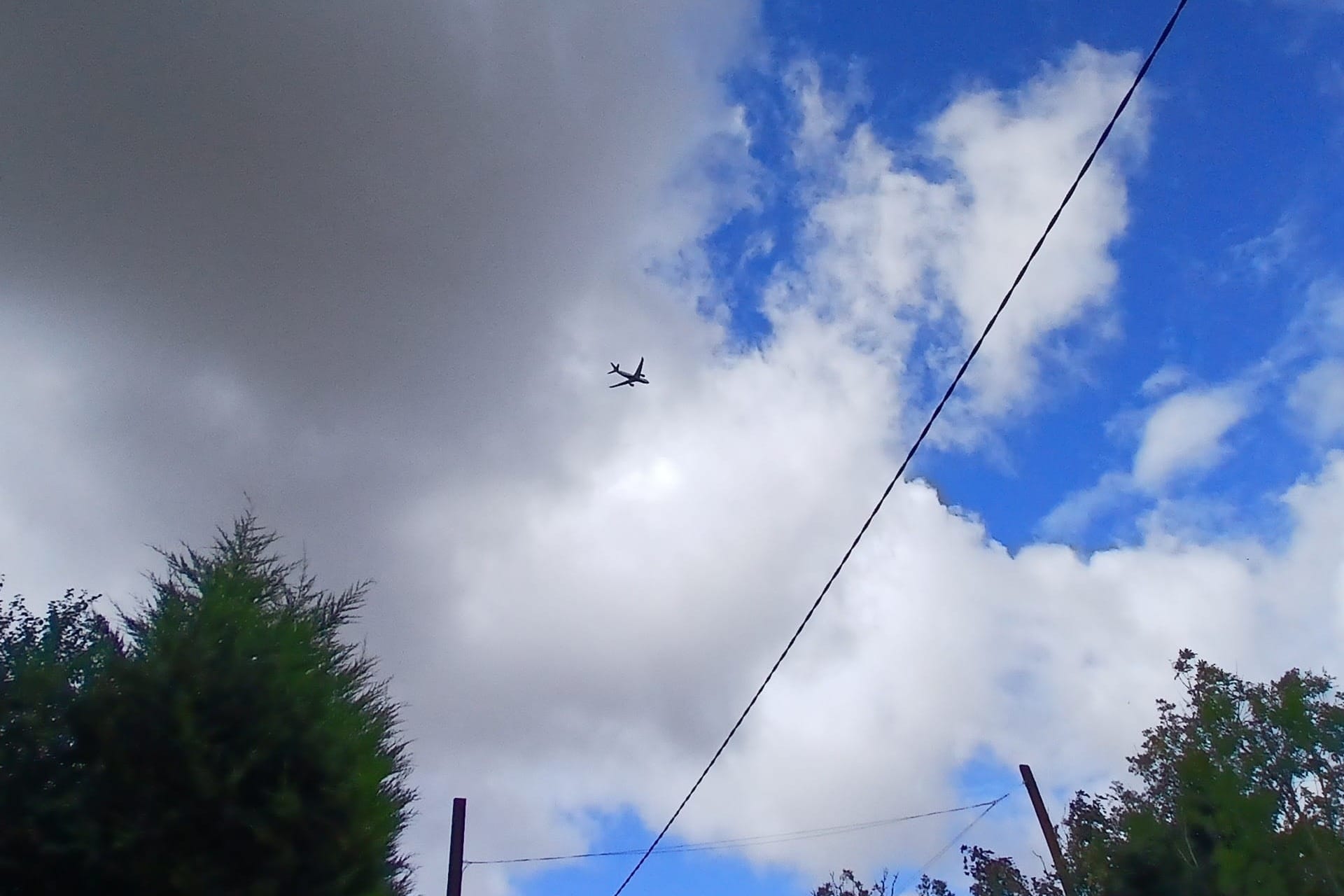
As if on cue, an airplane taking off from the airport roared over the golden farm field, over his house, and across the R121, climbing into the poofy white clouds above and disappearing.
"They weren't supposed to come this way," Farnham said.
Photo by Sam Tranum.
But with plans to lift the passenger cap, there are likely to be more and more flights passing over his home, he said, and more noise. "It's only going to get worse."
In DAA's summary of its environment assessments so far, it also looks at aircraft noise and vibration.
It models current operations, as well as future "do nothing" and "proposed order" (with the higher cap) scenarios, it says.
The assessment to date "indicates that the proposed order is not likely to give rise to significant aircraft noise or vibration effects", taking into account Aircraft Noise Competent Authority's (ANCA's) Noise Abatement Objective, it says.
Under "mitigation, monitoring and controls", it says "existing aircraft noise management measures include the North Runway Relevant Action, Noise Abatement Objective, Night Quota Scheme, fleet modernisation and a wider aircraft noise management regime".
In its summary of the impacts from airport operations on population and human health, should the cap be raised, it says it looked at the effects from "employment, economic activity, tourism, community amenity and health pathways associated with environmental effects identified in other technical assessments".
The assessment to date indicates that the order would give rise to "long-term beneficial effects in relation to employment, economic activity and tourism".
While effects on residential amenity and human health "are predicted to be localised and of negligible magnitude, with no likely significant adverse effects identified".
No extra mitigation, monitoring, or control measures are required, it says.
The roll-out of renewable energy generation is needs to be accelerated to hit Climate Action Plan targets, according to a report from the Climate Change Advisory Council.
The plans envision it as a park, not a site for housing. Environmental monitoring reports detail its impacts on surface water and ground water, as well as the gases it is emitting.