
What’s happened with Manna’s plan to expand its drone delivery service across Dublin?
It still only has one base, in Dublin 15, with planning permission – and that’s due to expire this year.
But the scheme is a success, said a council official's report, as that shows the cameras are a deterrent.

CCTV cameras put up in the north inner-city in August to combat illegal dumping haven’t caught anyone yet.
So said a report from Barry Woods, Dublin City Council’s head of waste management, that was presented to the council’s Central Area Committee on Tuesday.
His report cast this result as a success, saying it “demonstrates the cameras are proving to be a deterrent and a preventative measure to combat illegal dumping”.
But councillors at the meeting did not seem convinced.
The issue, they said, is that council staff say they can basically only identify and catch people illegally dumping if the dumpers arrive by car.
And in this part of the city, much of the illegal dumping is done by residents, who just walk out their doors and leave the rubbish nearby for council staff to clean up.
“The report shows zero detected offences, but we know we’re cleansing the streets and constantly removing bags,” said Fine Gael Councillor Gayle Ralph.
“So the dumping is happening and it’s not being captured,” she said. The system is “just not working”, she said.
In 2016, the Data Protection Commissioner put an end to the council’s use of CCTV cameras to film people illegally dumping, and post stills of that to publicly shame them.
For years after that, some councillors eagerly awaited new legislation that would again allow the use of CCTV to catch people dumping rubbish in the streets.
But when that legislation, and the regulations and policies that flowed from it, were finally put in place last year, councillors and council staff seemed to realise it wasn’t going to help as much as they’d hoped.
However, a council spokesperson said on 12 December that the the CCTV cameras are making a difference.
"Early indications show a dramatic decrease in incidents at the monitored sites, meaning the scheme is achieving its primary objective of preventing illegal dumping before it occurs," she said.
In early 2024, Dublin City Council put out a €4.5 million tender for a company to install CCTV cameras, and monitor them 24/7 for three years.
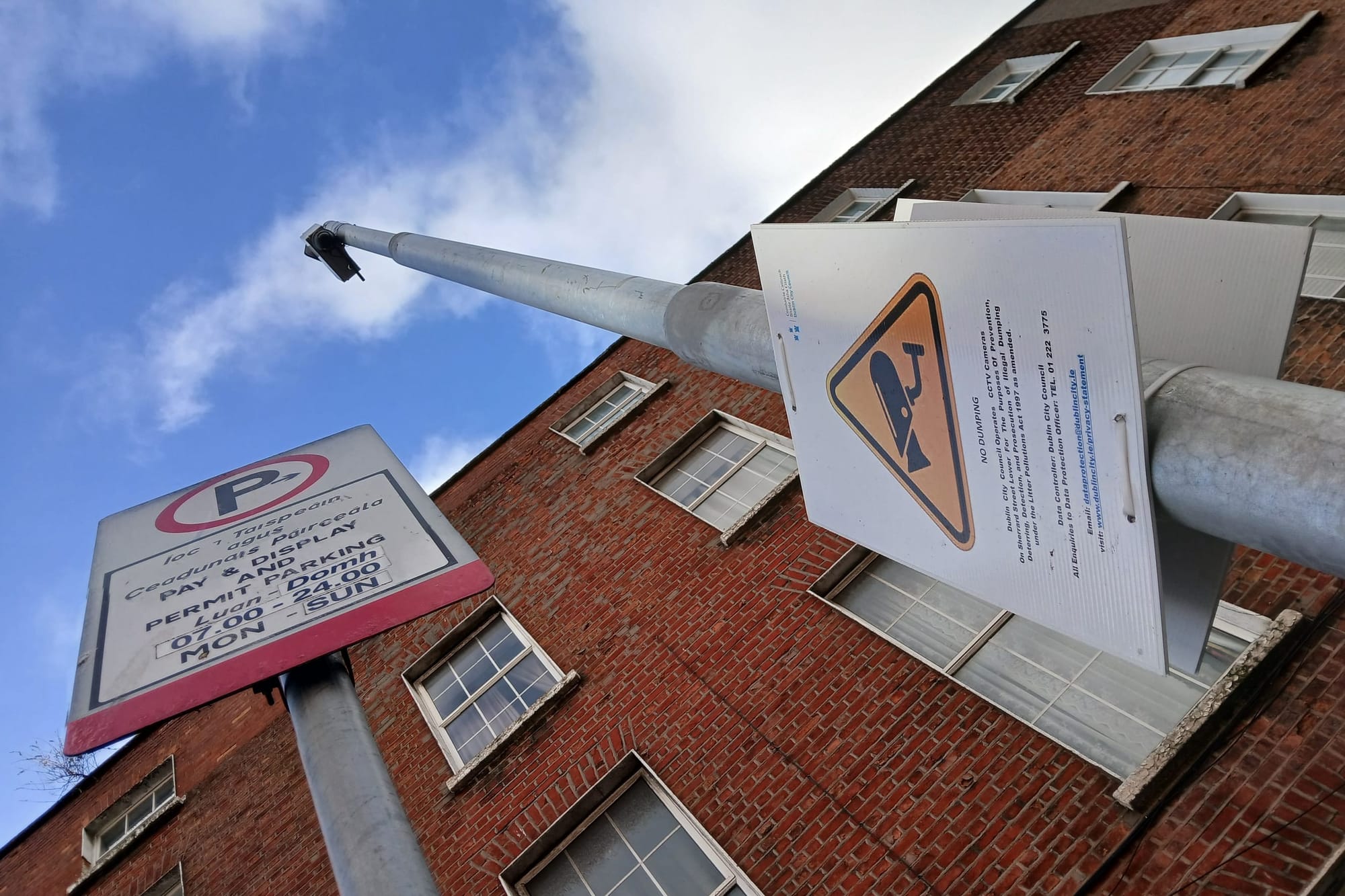
The cameras went live on 4 August this year, the report to the Central Area Committee said. They’re on Summer Street North, Belvedere Place, and Sherrard Street Lower.
On Wednesday, Summer Street North was looking neat and clean, with signs warning of the CCTV monitoring, and fines of €150, as well as fresh-looking footpaths and new plantings.
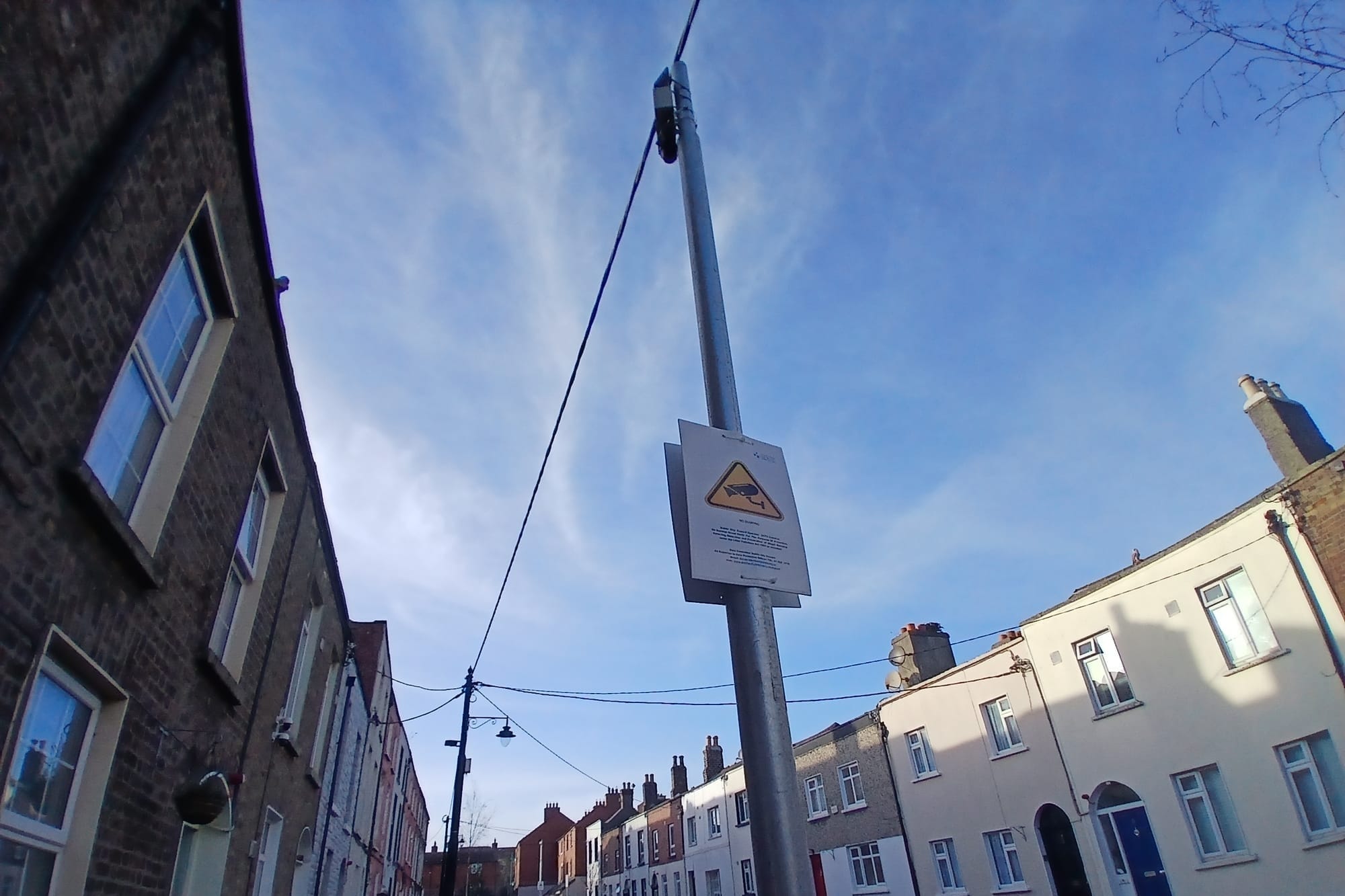
The part of Belvedere Place near the camera was, likewise, looking well.
But just across the laneway from the camera off Sherrard Street Lower, in front of a parked Audi, sat two black bags of illegally dumped rubbish.
This is a densely populated part of the city, streets lined with multi-storey terraced houses, subdivided into multiple tenancies.
Some people don’t know they’re supposed to either buy stickers to put on their bags and put them out on a specific day, or pay a company to get bins, councillors say.
Others know they shouldn’t be just leaving their rubbish on the street, but they do it anyway, they say.
Either way, the result is the same.
At the meeting, Fianna Fáil Councillor John Stephens said he’d met with residents around Blessington Street recently and talked about the situation.
“They said, basically, what’s happening is that residents and landlords are not paying for any waste collection so what happens is the bags are just dumped everywhere and then it’s up to Dublin City Council to collect the waste,” Stephens said.
Janet Horner, a Green Party councillor, who chaired Tuesday’s meeting, said by phone on Thursday that people living in that part of the city might see their neighbours putting out their rubbish whenever they want, for free, to be picked up by the council.
And they might wonder why they should keep their rubbish in their apartment until bin day, and then put it out and pay for the privilege of having a company pick it up, when they feel like they’re the only ones doing that, she said.
This is where the council’s enforcement efforts are supposed to come in. There are supposed to be consequences for those who don’t follow the rules – fines.
But none of the council’s efforts to catch and fine illegal dumpers in this part of the city seem to be working very well at the moment.
The council has two litter wardens in its administrative Central Area, which covers the north inner-city, Stephen Kavanagh, of the council’s waste management section, told councillors at the meeting on Tuesday.
They open illegally dumped bags to look for clues to who they belong to, Kavanagh said. “The success rate of going through bags isn’t great for evidence being found inside.”
People get fewer letters these days, and receive more correspondence online, he said. “Litter wardens aren’t getting the success rate we’ve had in the past,” he said.
Then there’s the new CCTV cameras. It takes a lot of admin work, and money, to install them, and they’re aren't many (yet, anway).
But, also, even in the very few locations where there are council CCTV cameras, and they do record people illegally dumping rubbish, the council can’t always use that footage to catch them, Kavanagh said.
When the council rolled out the CCTV, he said, “I highlighted the fact that CCTV wasn’t going to be able to identify people who are walking.”
If they get footage of a person getting out of a vehicle and throwing a bag of rubbish on the ground, they can try to use the registration plate to find that person.
Or if the camera catches the person walking out the door of their building, down the laneway, or wherever, and leaving a bag of rubbish on the street, that could help too, Kavanagh said.
“We can then try to deal with the landlord to identify them, but, again, if the landlord doesn’t play ball we have no way of identifying the person who is dumping because the majority of these houses on these three streets are let into eight, nine, ten flats,” he said.
Is any legal barrier to the council using CCTV to identify people dumping on foot?
A spokesperson for the Department of Climate, Energy and Environment said on 12 December that "It is an operational matter for each individual local authority to determine the most appropriate enforcement responses to incidents of illegal dumping, including the use of CCTV and other technologies, while taking account of local circumstances and priorities."
Indeed, in response to queries on whether the barrier to using CCTV to catch people dumping on foot is legal, or practical, a council spokesperson said it's a result of a choice the council has made.
"At present, Dublin City Council has chosen not to use facial images and has restricted evidential CCTV footage to vehicles only," she said.
"As one of the first Local Authorities in the State to operate CCTV fully in line with the new CCTV Codes of Practice, DCC wished to err on the side of caution," she said. "For future schemes, DCC will review whether the scope should be expanded to include facial images where necessary and proportionate."
Of course, even if/when the council has an image of the face of a person who's illegally dumping rubbish on the street, then they need to figure out who that person is and where to find them, if they're going to fine them.
To do this, "authorised personnel" would review the images manually, the council spokesperson said.
"To avoid confusion, using facial images simply means reviewing standard footage where a person’s face may be visible. This is distinct from facial recognition technology, which is not permitted," she said.
Although facial-recognition technology is available commercially in Ireland, for official purposes even the Gardaí are not allowed to use it.
Minister for Justice Jim O’Callaghan, a Fianna Fáil TD, now has cabinet approval to draft “heads of a General Scheme to provide for retrospective and live biometric identification” – including facial recognition.
However, this is in the context of giving Gardaí technology to investigate serious crimes, not giving litter inspectors technology to fine people for leaving a bag of dirty nappies on the street.
And giving the tool to Gardaí is not without opposition, either.
The Irish Council for Civil Liberties (ICCL) has said facial recognition technology is “a flawed but powerful technology that, when used by police, risks the misidentification of individuals as suspects for crimes and pervasive surveillance”.
“If introduced in Ireland, it would have an enduring and long-term effect on individuals’ ability to freely participate in public protest and move freely in publicly accessible places,” the ICCL says.
Without a viable way to identify people from images captured on CCTV, another possibility might be reviving the pre-2016 campaign of taking those images and posting them up in the neighbourhood to shame the illegal dumpers, even if the council cannot figure out what their names are and fine them.
But the council spokesperson said Friday that this is not possible. "Publishing images of individuals captured on CCTV for the purpose of 'shaming' them would breach the new CCTV Codes of Practice and the legal framework introduced by the Circular Economy and Miscellaneous Provisions Act 2022," she said.
It "would amount to an unlawful disclosure of personal data, unrelated to the permitted law enforcement purpose", she said. "It would also violate the principles of necessity, purpose limitation, proportionality, and data subject rights set out in the Codes."
At the meeting, Kavanagh, from the council's waste management section, sounded frustrated by the difficulties of catching people dumping.
“For us to stop that we really need to be there at the time, with litter wardens, with the guards present to get details from the people,” he said.
“And it’s not always, obviously, that’s not always – you cannot always get the guards to help us, we can’t always, litter wardens can’t always be there – and a lot of this is being done overnight,” he said.
So if CCTV hasn’t turned out (yet) to be the great anti-dumping panacea that some councillors perhaps hoped it might be, then what else can be done?
Another enforcement-type effort the council is working on is its “reverse register” project.
The idea there is for the council to get from bin companies a list of all their customers on a street.
And then knock on the doors of all the addresses not on that list, and ask people to prove they are disposing of their rubbish legally – and fine them if they can’t.
This project is still in the early, small-scale, pilot stage.
Beyond enforcement efforts like these, a more fundamental reform is also under consideration, which some believe could help tackle illegal dumping: giving councils back control over bin collection.
Before 2000, Dublin City Council collected bins, but households didn’t pay a separate charge for that. Later, government policy allowed private operators to begin collecting waste alongside local authorities.
In 2009, a waste-collection company brought the council to court under competition law – and the council left the household bin-collection business in 2012.
Today, any company that gets a waste collection permit can come to Dublin and offer their service. The council does not have control over the waste-collection companies, or how they operate in the city.
For the last several years, there’s been a push by some political parties, and unions, to “re-municipalise” bin-collection in the city – though that term seems to mean different things to different people.
It could mean a return to a world in which council staff collect bins.
But what the government seems to be looking at, instead, is a “franchise tendering” system, where the council would contract out the job of collecting bins – maybe with different companies getting different territories within the city.
Either way, that could give the council the ability to remove or subsidise – for people on low incomes – the cost of the service.
Last year, Adrian Kane, an organiser for the union SIPTU, told an Oireachtas committee looking at the issue that a lot of households in Dublin don’t have a bin-collection service.
“There is a causal link between that and the amount of illegal dumping,” Kane said. “That cannot be overcome unless people are obliged to have a service, which cannot be done unless there is some way in which poorer households do not have to pay the full whack with regard to it.”
Conor Walsh, secretary of the Irish Waste Management Association (IWMA), suggested a voucher system.
“Like people get a fuel voucher, they would get a voucher from the Department of Social Protection that pays a certain amount towards their waste collection,” Walsh said. “Perhaps then people who cannot afford the service could afford the service and would not resort to illegal dumping.”
The Department of Climate, Energy and Environment ran a public consultation from May to June this year, on the feasibility of transitioning to a franchise tendering system, which it framed as a way to “support the achievement of EU recycling targets”.
On 4 November, the department official refused a request under the Freedom of Information (FOI) Act for the submissions it collected during this public consultation – which would have made it possible to see what companies, associations, government bodies, or individuals were pushing for what outcomes.
In a letter, John Barry, a higher executive officer at the department’s Circular Economy Strategic Policy Section, explained his reasons.
“I am withholding access to 289 records in accordance with Section 29 – Deliberations of FOI bodies,” Barry wrote.
“The records being sought are part of a wider ongoing study which is planned for publication in 2026,” he wrote. “It would not be in the public interest during the deliberative process in carrying out the study in question to release these prematurely.”
Another “82 of these records I am also withholding under Section 37 – Personal information. Granting access to these records would involve the disclosure of personal information,” he wrote.
Mark Ward, a Sinn Féin TD representing Dublin West, asked in a parliamentary question when the report coming out of the public consultation might be published.
The public consultation was meant to inform “a comprehensive year-long independent study”, replied Alan Dillon, a Fine Gael TD, who is a Minister of State at the Department of Climate, Energy and the Environment, on 1 October.
The final report is “currently scheduled for completion in March 2026”, he said.
UPDATE: This article was updated at 15.00 on 12 December 2025 to include comments received that day from a Dublin City Council spokesperson.

The numbers spiked after a new cohort of councillors was elected in June 2024, and have eased somewhat since then – while remaining higher than before.

After The Currency reported the idea of the council moving its HQ, councillors were talking about and thinking through the pros and cons and implications.

They are shunted into a bumpy sliver of gutter between the kerb and the Luas tracks.

“It’s probably fair to assume that if the DFA said anything positive about Algeria’s human rights record, they wouldn’t be so determined to withhold it.”