The company's application includes preliminary results of its assessments of the environmental impacts of raising the cap from 32 million to 40 million passengers per year.
The roll-out of renewable energy generation is needs to be accelerated to hit Climate Action Plan targets, according to a report from the Climate Change Advisory Council.
Longtime city clampers DSPS, after losing a competition for the council's new contract to rival APCOA, have challenged that decision in court. It's not over yet.
New play unfolds in a playground, decades after a Dublin housing estate riot
"Thérèse" is a story about grief, classism, womanhood, generational trauma, and the weight of a life watching injustices stack up on top of each other.
At the height of the pandemic restrictions, director Veronica Coburn and writer/actor Louise Lewis met for a socially distanced outdoor coffee, on a park bench in the Iveagh Gardens.
Lewis told Coburn about an image that she had stuck in her head.
It was of a 10-year-old child standing on a hill in the middle of a Dublin housing estate in 1989, looking down into the green, as a riot is unfolding, Coburn recalls, as she sips another coffee – this time in the café of Blanchardstown’s Draíocht arts centre on Wednesday morning.
“There's fire brigades, there's young kids, but there's no police cars, because the police won't come, and then because it's getting out of hand, army tanks arrive to control the situation,” Coburn says.
Lewis asked Coburn to help her develop that central image into the new play, Thérèse – running in the Draíocht from 5–12 September as part of the Dublin Fringe Festival.
From it grew a story about grief, classism, womanhood, generational trauma, and the weight of a life watching injustices stack up on top of each other.
Rehearsal
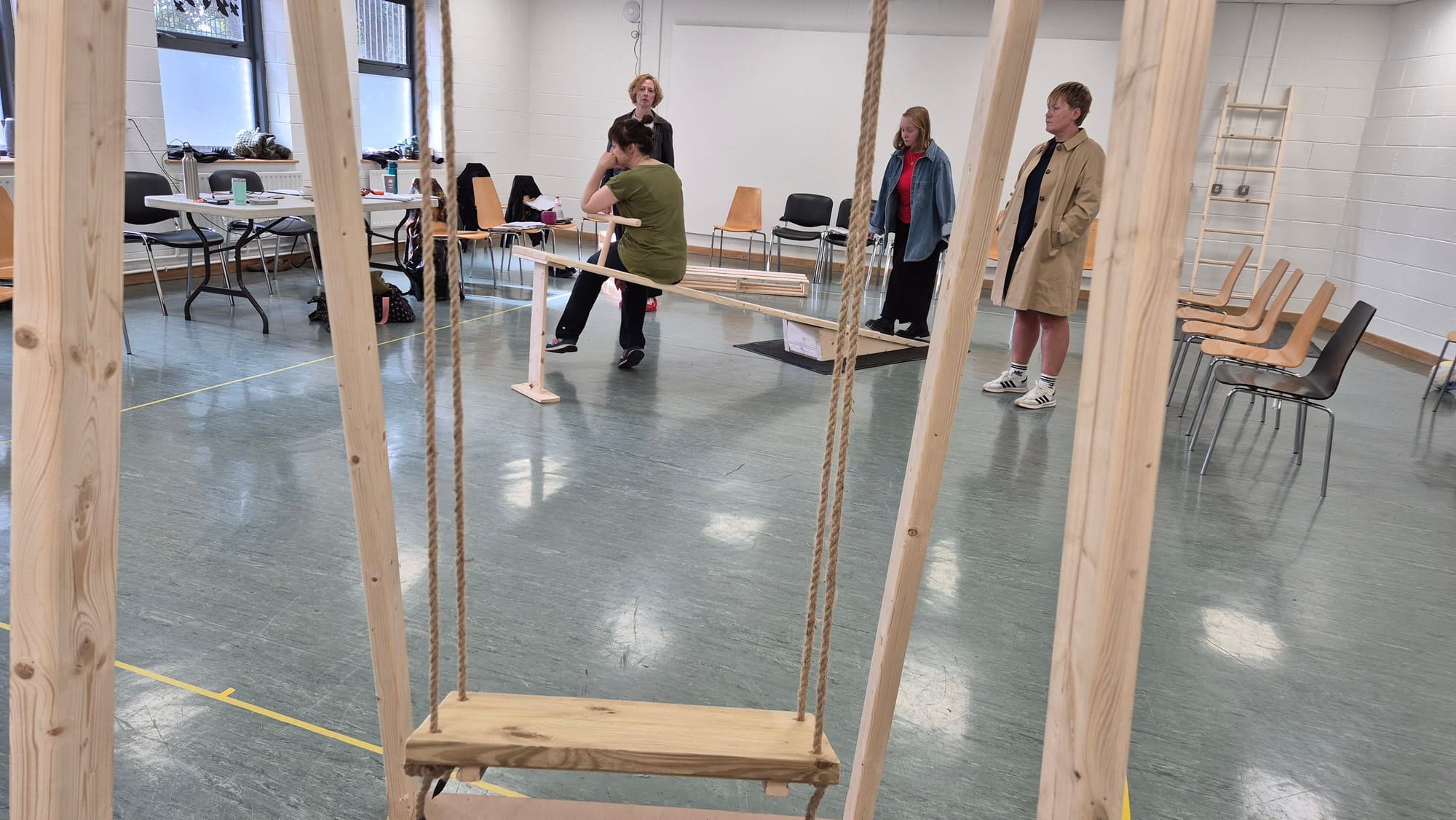
Inside the rehearsal room in the Draíocht, a large wooden swing sits in one corner.
A wooden ladder rests against the wall in the opposite corner, and in the middle, a sort of ramp/seesaw-hybrid.
Because this story unfolds, in its various layers, in a playground – decades after that housing estate riot.
But before they get to work, the cast and crew all start the day with a game of keepy-uppys.
The aim is to get to 50 passes of the football without a drop, but heading into their third week of rehearsals, they haven’t hit the target yet, they say, all laughing.
“The script began as a single text for one person and it’s grown to include this feminine chorus,” says writer Lewis, who also plays the lead, Thérèse.
Thérèse, the child on the hill now grown-up, is coping with the unexpected, untimely death of her young brother, and there to help her are three other mothers, each minding kids.
The chorus is played by Aoibhe Beaumont-Walsh, Amy Conroy, and Orla Fitzgerald.
Conroy’s character is in the playground looking after her grandson, Fitzgerald’s character is there with her own child, while Beaumont-Walsh, the youngest, is minding somebody else's kids.
At times, the individual women are there in the present with Thérèse, chatting, reassuring, supporting.
As Thérèse’s mind suddenly slips back into an uncomfortable memory, like that estate erupting years earlier, the chorus actors fade into the background, their murmuring voices phasing in and out, evoking that battle between past and present that our lead is in the throes of.
At times the chorus voices, in the present, will also unite and speak in unison.
They are representing the experiences of all women in those moments, says Coburn.
Elsewhere, Thérèse points her questions, her frustrations, upwards at “the gods” – the play’s stand-in for the Irish state’s political leaders.
“Because all of those injustices, like the societal injustices that we're all dealing with, are a result of the decisions that are made by the powers that be, and in our play, we call the powers that be the gods,” director Coburn says.
As the loose, thin veil between past and present begins to slip, Thérèse is back again on that hill watching the horror.
She calls to her mother. “It’s the army mam!” she says. “They’ve never sent the army before.”
“It’s tough to raise kids in estates that have been forgotten,” Conroy’s voice says, peeling out of the murmuring chorus.
“The upper echelons pretend we're not here on this island, this capital,” Thérèse responds, seething.
“No politician has to pass through here to get to their house, so we're not here. We don't really exist,” she says.
Politicians only act when everything “explodes”, and they need to stop it spreading out of the working-class areas, like a “disease”, says Thérèse.
People see war as just something on the telly, happening in other countries, she says. “They don't believe what we have is also a war.”
“Children going to bed hungry, abandoned, practically rearing themselves. Abuse, drugs, fear of going anywhere after dark,” she says.
“Anti-social behaviour is a war, isn’t it?” Conroy’s voice softly cuts through.
“Yeah, it’s just a different type,” responds Thérèse.
Collaboration
“We are figuring out costumes,” said actorOrla Fitzgerald, well-known for her starring role in Ken Loach’s The Wind That Shakes the Barley, before the rehearsals got underway.
“Am I wearing a dress? Am I wearing trousers? So I brought in a dress from home today,” she says.
While the three chorus players aren’t named in the original text by Lewis, each actor is given the space to develop their own character and backstory.
Fitzgerald has decided her character will be named Maeve.
The three women’s job, she explains, is to help Thérèse, who is “stuck in grief”, to move on.
“We've all sorts of reasons where we all kind of connect with Thérèse in our own way,” she says. “We've all suffered grief.”
Fitzgerald’s Maeve is the more middle-class of the bunch.
The others scoff when she mentions her favourite brand of cheese and onion, as if she should consider herself above eating regular old crisps.
But Maeve, whose father died young, is more “middle class poor”, Fitzgerald says. “It was scrimping and scraping.”
“There's assumptions made about me that I am very middle class from a middle class upbringing,” she says. “Whereas I'm like, ‘no, you don't know my full story.’”
This all-get-stuck-in approach is the “heartbeat” of the production, says Lewis, the writer who also stars in the eponymous role.
“It’s been very collaborative in how the chorus has grown through the different development stages,” she says.
When she had the idea for a new play, she knew Coburn was the person to bring it to – to start teasing things out.
“Her response to the image of the child looking at these tanks was full of wonder and positivity and it’s continued that way through this whole journey to production,” she says.
Photo by Eoin Glackin.
Like keepy-uppys … on a surfboard
The play runs for 90 minutes, with no interval and no separate acts, like a feature length film shot in one take.
It flows on seamlessly, while also jumping back and forth across decades, between memory and the present moment.
It takes a lot of concentration to keep the energy up, because the piece is so alive, says actor Amy Conroy. “You can't just say words; you have to feel your way through it.”
Ultimately the goal is to get to the point where the cast bounce off each other, guiding and harnessing each other’s energy, like that warm-up game of keep-uppys, she says.
“Or it’s like a surf board, we all just have to get on the board at the same time and then the wave of it will take us wherever it takes us,” she says.
While they are now in full rehearsals, the cast and crew have been working behind the scenes in the development phase, on and off, for several years now, says Aoibhe Beaumont-Walsh.
The youngest of the troupe, Beaumont-Walsh graduated from a drama course in TU Dublin in 2024, and was offered the gig by Coburn, who had spotted her in college.
She has been involved in the show’s development for the last two years, as Coburn and Lewis were still figuring out exactly what they wanted it to look like.
Is she nervous about the 90-minute non-stop performance?
“I don't find it that nerve-wracking because I always have felt like the piece breathes,” she says. “It really moves, like it carries itself almost.”
“Also, we've got each other's backs,” she says.
From that pandemic coffee chat in the Iveagh Gardens to a full stage production, Lewis says it’s incredible what has grown from that first seed of an image – that young child on a hill in a working-class Dublin estate watching horror unfold.
Of the wider cast and crew, says Lewis:
“The talent, experience and kindness they bring to the room has allowed us to push the boundaries of the performance of this script way beyond where I thought it could go.
“To be performing alongside them in Thérèse is definitely the cherry on top of this incredible journey.”
Longtime city clampers DSPS, after losing a competition for the council's new contract to rival APCOA, have challenged that decision in court. It's not over yet.