

Dublin city councillor proposes reducing contacts with US government, given its crimes
Although it’s unclear exactly what the council could do on this front.
It has until 2030 to roll out points for ships to plug into the electricity grid, if it is to meet an EU deadline.

Emissions from the massive ships that dock at Dublin Port haven’t featured much in discussions at Ringsend Irishtown TidyTowns & Environment (RITE), says its secretary, Mary O’Neill Byrne.
She and members talk about air pollution, she says.
She sometimes glances at the readings from the Ringsend monitor on her phone. “But I don’t even understand what that means, how bad is that.”
Members would be more conscious of fumes from buses and trucks than anything spewed out by ships, she says.
But the question of pollution at the port interests her, she says. “We’ve never had anybody talk about pollution and the port.”
“I would love to see if there are any groups that know more about it, who could come in and give a workshop,” she says.
Research and government reports do show the scale of emissions spat out by the big ships at Dublin Port, which serves as the main gateway for food, machinery, fuel, goods and raw materials into Ireland.
An average of 4,100 big container vessels, cruise ships and the roll-on-roll-off ferries berth at the port each year, says a report by the Marine Institute. Running on diesel, they emit about 68,700 tCO2 a year while at berth, they say.
By comparison, outside of the big national industrial infrastructure on the peninsula, Codema, the energy agency, estimates that activities in homes and businesses, and getting around, in Ringsend and Poolbeg accounted for about 14,600 tCO2e in 2018.
Meanwhile, results from the PortAIR project “indicate that ships are a major source of air pollution in Dublin Port and can affect the surrounding local area to some extent”, said John Wenger, a professor of chemistry at University College Cork.
During 2022, ship emissions were estimated to contribute 21 percent of the fine particulate matter (PM2.5) in the port, said Wenger, which is “the pollutant which has the largest impact on human health”.
Dublin City Councillors finally got sight last month of the roadmap to slashing carbon emissions in Ringsend and Poolbeg, which has been designated by the council as a “decarbonizing zone”.
The council’s target for the area aligns with national targets – to cut greenhouse gas emissions by 51 percent by 2030, and reach net zero no later than 2050.
O’Neill Byrne, who was involved in the workshops that informed the report, said community groups’ concerns around pollution largely focused on vehicle traffic.
As big emitters though, tracking what Dublin Port – and other critical facilities – are up to would be important, says O’Neill Byrne. “I suppose they should be more involved and should be stating their case and what they’re doing.”
The decarbonizing plan doesn’t count the big industrial and commercial entities, though. Staff at Codema, who authored the report, gave a few reasons for that.
They would need bespoke analysis, the facilities serve a wide area, and influencing their emissions would be hard with local measures alone, it says. Also, they are usually subject to other European Union regulations around emissions reduction.
Indeed, one major change that Dublin Port is expected to make, as mentioned in its current masterplan, is to build out shore-side electricity facilities at all new berths.
Vessels won’t have to leave their engines idling while docked, it says. They could plug in to the grid instead which should lead to a “moderate reduction” in local air emissions at the dockside, says the masterplan.
These would be “initially in the Alexandra Basin West area, then in the Unified Ferry Terminal and then at the Poolbeg deep water berths, reducing air emissions, carbon usage and, noise levels”, it says.
The roll-out of shoreside power across big ports in Europe is actually driven by the European Union’s Alternative Fuel Infrastructure Regulation, says Eloi Nordé, the shipping policy officer at the environmental lobby group, Transport & Environment.
Dublin Port needs to install 16 onshore power connections by 2030 if it is to meet the deadline in the regulations, she said.
These onshore power supplies instantly remove emissions by plugging the ship into the local electricity grid, she says.
Between 5 percent and 7 percent of all shipping emissions are emitted in ports, she says. “On top of CO2 emissions, these are vast amounts of sulphur and nitrous oxides that are emitted in EU ports each year.”
Once onshore power points are installed, ships larger than 5,000 gross tonnage have to connect when they are in ports covered by the regulations, she says.
“A number of exemptions exist though,” says Nordé – for remote islands, allowing for weather conditions, and grids at risk.
A spokesperson for Dublin Port couldn’t give a timeline for when its onshore power connections will be up and running – and so whether it will meet the 2030 deadline in the regulations.
The port is working on plans to roll them out, said the spokesperson. Ducting and civil engineering works have been done as part of recent construction projects, said the spokesperson.
The port is also engaging with ESB Networks on the infrastructure and grid requirements that the port has to meet government targets, they said.
An October 2024 report by the Marine Institute noted that, to make all this happen, the existing medium voltage network needed replacement, given it has been “operating at capacity, incorporates obsolete equipment and both equipment and cable that has exceeded its design life”.
That posed challenges, it said, citing the ability of ESBN to increase its load to around 30MW, cost, phasing, and the tight timeline if the 2030 deadline is to be met.
A spokesperson for ESB said it has regular engagements with the port about upgrades. “We have significant reinforcement works scheduled in this part of Dublin as part of our PR6 investment programme out to 2030.”
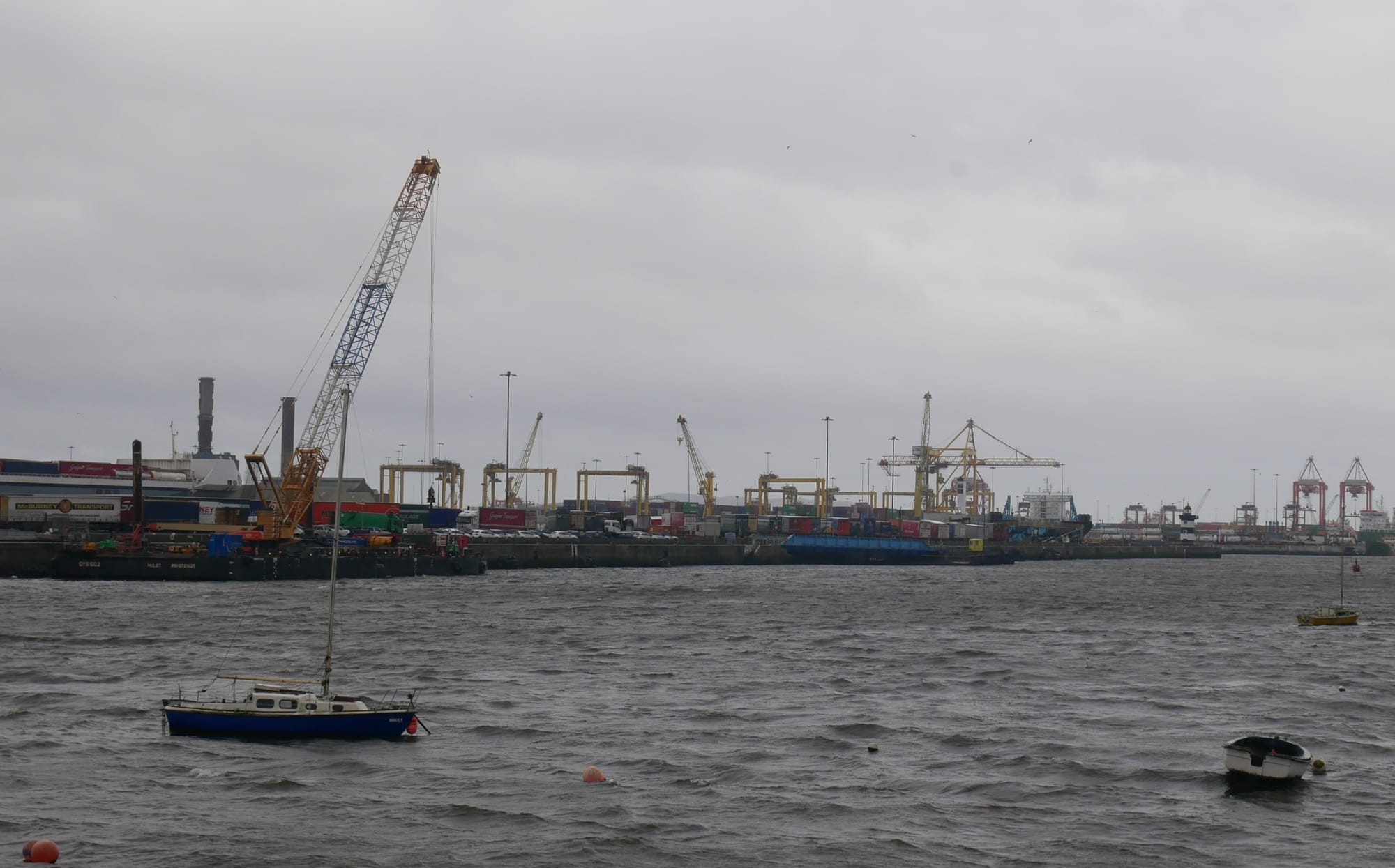
Wenger, the professor of chemistry at University College Cork who coordinated the PortAIR, says that the research captured when ship emissions such as PM2.5 peak.
The findings? “Ship emissions were at their highest while manoeuvring in and out of the berth, while smaller amounts of pollutants were emitted over a longer timescale when vessels were docked,” he said.
So connecting ships to shore-side electricity while they are in berth would help reduce emissions, he said. But still leave significant emissions as they maneuver in and out of berths, he said.
Wenger says that one way to tackle maneuvering emissions is by the introduction of a “designated Emission Control Area for the North-East Atlantic region” and switching to cleaner fuels, and to renewable energy sources.
Dublin Port already is a designated Sulfur Emission Control Area (SECA), which reduces sulfur-dioxide pollution, he says.
But further improvements could be made if the port was also part of a Nitrogen Oxide (NOx) Emission Control Area (NECA), he says.
That would require ships to be fitted with pollution-abatement technologies – and so cost money, he says.
A spokesperson for Dublin Port said that it is “engaging with operators about their plans, particularly as they modernise their fleets”.

Although it’s unclear exactly what the council could do on this front.

“You could get 500 emails, and I do recall my friend saying ‘God, why don’t you get Copilot?’”

“I was advised that one deportee had been restrained in order to have him escorted through airport security.”

The bones are thought to come from the major medieval monastery at St Mary’s Abbey, and further excavation works are ongoing.