
Central government is looking at whether councils should be allowed to borrow more, to build more
The current restrictions do need to change, said a spokesperson for the Department of Finance.
Libraries aren’t just places to pick up books these days, says Aisling Earley, a library assistant.

In the calm Coolock Library on Thursday morning, people are scattered in corners and on couches, reading or researching on the in-house computers.
Faint chatter washes over from the far side of the main library floor.
Following the hum leads up a small hallway and into a big event room, with a huge white table.
Around the table, 15 or so women are settling in for the weekly two-hour crochet group – although some prefer to knit.
Dubliners are checking more books and stuff out of libraries year on year, figures show, up from 1.5 million items in 2022 to 2.5 million in 2024.)
They’re also just visiting more.
Many still think of libraries purely as places to pick up books, or a quiet place to study, but Dublin City Libraries has been working hard to expand the services it provides for communities, says Aisling Earley, a library assistant in Coolock.
And it’s all free, she says.
In the event room, a square blanket, a few metres wide, is sprawled out on the table. It has bright colours – purple, green, orange, white and yellow – in a circular pattern.
The blanket has taken three and a half weeks, says Geraldine Shortall. She plans to send it as a gift to her son-in-law in Brazil.
The group around her all fawn over the impressive work.
“Isn’t it just gorgeous,” says Pauline Emmett, from the other side of the table, looking on – her own hands busy with needles and wool.
The gathering is quietish today, she says. Nearly twice the numbers turn up some weeks – so many that they need to drag in more tables.
Aside from the crochet group, there are a bunch of things on offer in Coolock Library that people might not automatically associate with libraries.
Like video game nights, cinema screenings, free access to 3D printers and sewing machines, and sensory evenings.
There is no one teacher in the group, everyone helps each other out, Emmett says.
“It’s called a ‘granny square’,” she says, of the small baby blue piece she is working on. “Once you can do that, you’re laughing. We all had to start at some time.”
As she works, several finished granny squares are placed on the table in front of her. Eventually, they’ll be stitched together to make a bigger piece.
Emmett is making a “quillow”, she says. A quilt that also folds neatly into a square pillow.
It’s not for her, she says, but for the children of St John’s Ward in Crumlin Hospital, a 19-bed inpatient unit.
She makes them regularly and sends them in, she says, as do others. “The kids love them.”
They make them in all different colours, sometimes to match a particular football team, she says. The kids get to pick one each when they are in the hospital and can then take it home.
Much of what people in the group make is for others, she says – and often for charity.
One member who isn’t at this Thursday’s session crochets small gowns for premature babies, says Emmett.
“Is that a bag you’re making?” Emmett asks Noelle Melinn, across the table.
“Don’t ask,” Melinn says, as everyone around her lets out laughs.
Melinn recently raised €1,000 for charity selling crocheted Christmas trees, Emmett brags on her behalf.
The money raised went to St Paul’s Special School in Beaumont for children with Autistic Spectrum Disorder (ASD) diagnosis, Melinn says.
She is a member of another crochet and knitting group too. That one’s called the St Paul’s Knitters.
Her work in both groups is often used to fundraise for the school, she says. “We raised a lot of money that went towards making the sensory room in the school.”
Money that she helped raise recently also went towards buying a young child who was born blind a special computer that uses braille.
He had access to one in school but not at home, she says. “It gives him an extra chance.”
To see tangible impact is gratifying, she says.
“Knowing that you’re helping to set these kids up for life is just brilliant,” says Melinn. “It’s great to give back.”
Melinn is dubbed the “Queen of Borders”, says Anne-Marie Keeley, further down the table.
Her blankets have beautiful edges, Keeley says. “Her work is out of this world.”
Keeley is busy working on a blanket of her own. One of Keeley’s creations was recently sold at a charity auction for €700, she says.
The woman who bought it wanted it for a child with autism, she says. “It’s a textural thing. They love to feel the patterns in their hands, and the bright colours.”
Keeley turns to the woman next to her, Geraldine Murtagh.
“What are you making?” asks Keeley.
“A hedgehog,” Murtagh replies, chuckling to herself.
She made one before. Someone asked her to make another, again for a child with autism. Hedgehogs can be tedious to make, she says, but she happily obliged.
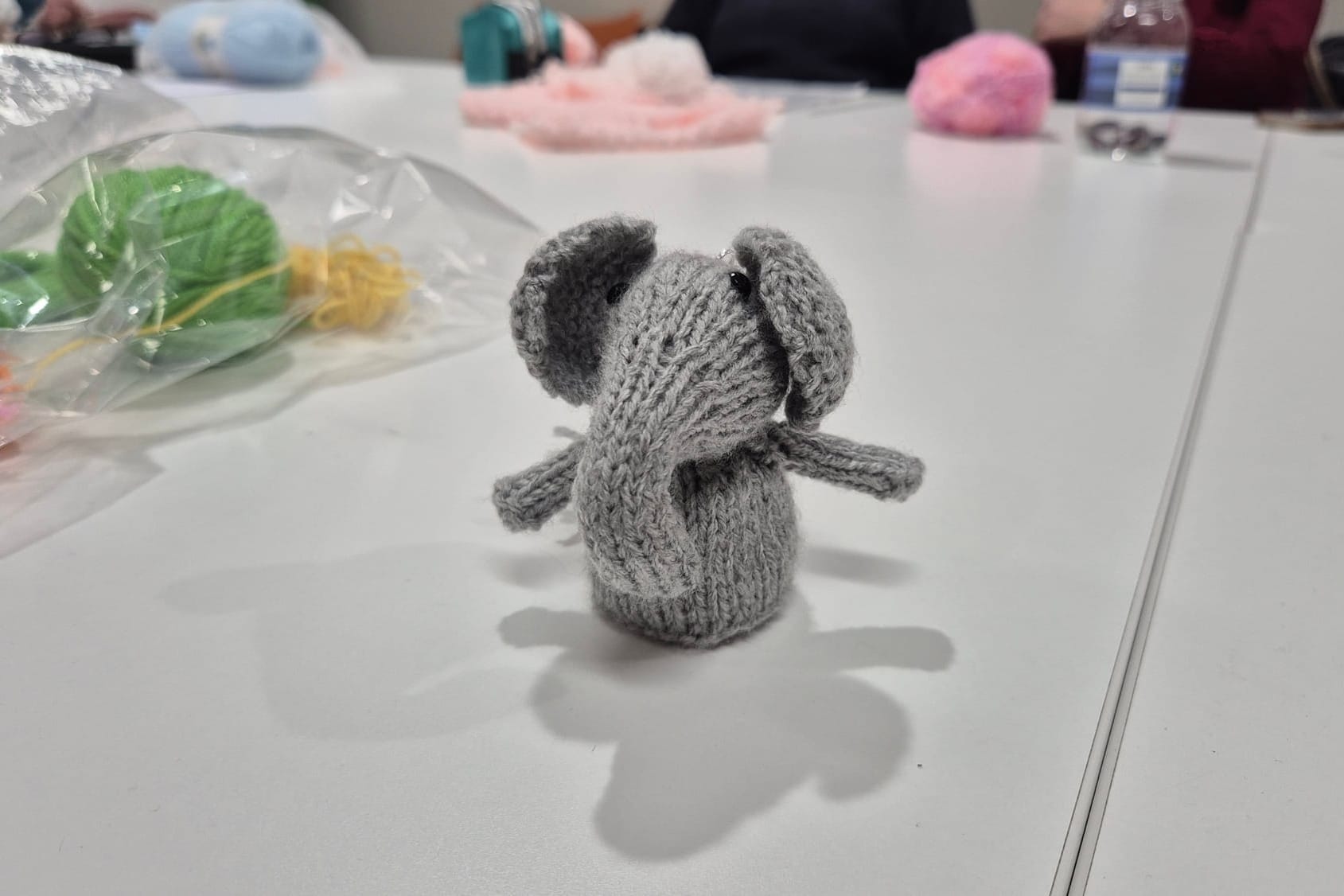
“I love making toys,” Murtagh says, gesturing towards a small crocheted elephant.
The camaraderie of the group doesn’t stay at the library. They sometimes go on day trips together.
Often, to hunt for wool, says Melinn.
Like to the Wool Gallery in Gorey, she says. The owner gives them discounts and covers postage when they can’t collect it in person. “That’s her way of helping the charity work we do.”
She’s just brilliant,” says Melinn.
“Loneliness is a terrible thing,” says Emmett.
The friendship and support from the library crochet group has been important to her in some difficult times, she says. “It’s gotten me through three big operations.”
Many attend other activities too.
Geraldine Murtagh was recently at a screening of the original Westside Story, held in the same event room.
One Friday a month, the library holds its “silver screen” movie morning, says Earley, the library assistant.
They show old films, offer tea and coffee. The next silver screen showing is Tootsie, at 11am on 30 January.
On 24 January, the library will host its monthly family film. This time, it’s the 2003 classic, Finding Nemo.
In the library’s Maker Space room, a 3D printer hums softly. The machine is building a white figurine.
Someone just brought in a USB stick with the design they wanted. Staff uploaded it to the machine for them.
It’s also totally free for the public, Earley says – including the filament material the 3D printer uses.
In the Maker Space, people also have access to machines for sewing and embroidery, she says.
On Wednesday evenings, the event room where the crochet group meets is turned into a video game hub for youngsters, she says.
TVs are hooked up with consoles around the room. An old-school Pac-Man arcade cabinet is rolled out.
Many people don’t realise that you can also borrow video games, Murtagh says, as well as films and box sets on DVD.
The library is always looking for new ways to engage with and serve the community, she says.
This month they are holding a mental-health workshop, for dealing with the winter blues, she says.
Funded by the Local Democracy Reporting Scheme.

It’s timely, says Alison Field of Labour, with the 85th anniversary of the devastation approaching and the world as it is.

It showcases films made on a short timeline with zero budget. "It's definitely a shit show, the no-budget, DIY spirit of it," says Morgan Savidan.

"We're kind of slagging ourselves, calling ourselves The Watchers."

Dolce Sicily co-owner Fabio Bonaccorsi said its numbers say tiramisu is trendy. Other establishments say tiramisu is always popular.