
Central government is looking at whether councils should be allowed to borrow more, to build more
The current restrictions do need to change, said a spokesperson for the Department of Finance.
Black belt Philip Condron has just landed a dream role in the latest Ip Man film, in Beijing.

“Make sure those punches are straight shots, down the centre line of the body,” Philip Condron tells one of his students.
Condron walks to one of the five punching bags lined up along the side of Vieira Martial Arts gym, tucked away in North Lotts, behind Bachelors Walk.
He assumes a stance, feet just a little more than shoulder width apart, and raises his guard.
Dressed in black, standing six-foot tall, with a solid muscular frame, he might seem physically imposing, if not for his youthful, infectious energy and near-constant smile.
As he strikes the bag, his back foot, raised on its ball, moves from a 45-degree angle to a straight line pointed in the same direction as his fist, towards his target.
His punch snaps out and with a loud smack, it connects with the target – followed by a lingering squeak as the bag swings back and forth.
He resets his stance.
Drawing attention to his own footwork, he says: “That’s where the power comes from.”
The student nods in appreciation for the tip, and gets back to practising the combination she’s working on with her training partner.
On the face of it, this looks like an ordinary martial arts class. Students are paired up to work on combinations of kicks, punches, chops, parries and blocks.
However, unusually, taking hits yourself is worked into the routine – kind of.
Students theatrically react to punches that just miss their face or body as if the strikes really connected.
When kicked lightly in the chest, they tumble backwards like they’ve just been hit by an imaginary car.
Because despite how it first appears, this isn’t technically fight training – this is choreography.
It’s a practice session of Condron’s Screen Combat Ireland – billed as Ireland’s first dedicated screen fighting school for TV and film, which he started in 2018.
This is where Condron’s love for both the fighting arts and film making come together, where his years of training and studying coalesce.
About an hour into the class, among the punching bags, boxing ring, gloves, medicine balls and pads, Condron produces a piece of training equipment less associated with martial arts gyms.
From his large green backpack, secured with a chunky padlock, out comes a Sony A7 III camera – with an extra view screen attached on its top.
It’s time, he says, to see how the choreography looks on film.
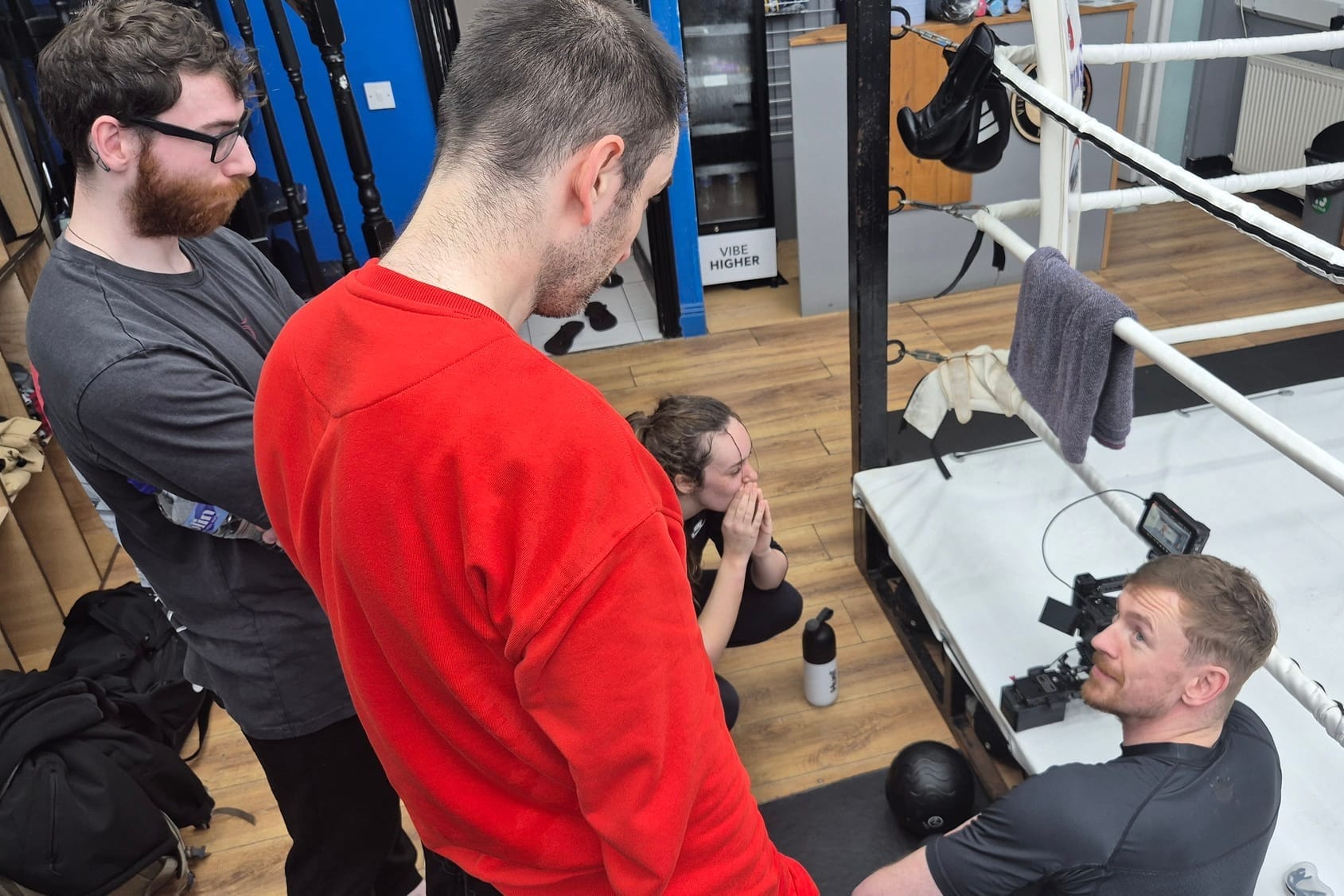
Among Sunday’s class is actor Aoife Commons. With no prior martial arts experience, she’s now a few months deep with her training, and has loved it since day one, she said by phone on Thursday.
“The first class coming in, Phil is so accommodating to everyone's ability straight away,” she says.
“Starting off, I couldn't throw a kick, I couldn't throw a round house or anything. Now, I go into class and think, ‘Right. I know what I'm doing,’” says Common.
Ireland needs really good stunt performers, who are actors as well, she says.
While she doesn’t have any desire to perform back flips, she says she’s always wanted to do some of her own stunts.
“Even if it's short choreography, to do close-up shots of fighting. I've always wanted to do that,” she says.
Condron’s unwavering love of all things martial arts and filmmaking led to his latest professional achievement, far from the North Lotts training mats.
During the summer, he was invited to Beijing to play a “final boss villain” in the latest Ip Man film – Ip Man: Kung Fu Legend – opposite Dennis To in the leading role.
The real-life Ip Man was a grandmaster of the Chinese martial art Wing Chun, and famously trained a teenage Bruce Lee in 1950s Hong Kong.
Now a legendary figure, his life has become the focus of big-screen adventures – blending history, politics, action and fantasy.
For Condron, the role ended up a poetic reminder too of how far he had come.
In his mid-teens, Condron had a few run-ins with bullies. He turned to karate.
“The classic response,” he says, with a chuckle.
First trying his hand at the traditional Okinawan karate style of Shotokan, he found the training uninspiring after a while.
So, he moved on to American Kenpo Karate – a more modern hybrid style, incorporating elements of traditional Japanese karate, Chinese kung fu, boxing, judo and Filipino fighting arts.
After his first class with Shay McNamee at his Martial Arts Academy, Condron says, he had found his new home.
McNamee was awarded his tenth-degree black belt, the highest rank, at a ceremony in Las Vegas in 2022, in recognition of his lifelong commitment to Kenpo.
“It was the real Mr Miyagi/Daniel-san relationship,” Condron says.
He couldn’t afford to pay for classes, he says, so McNamee would train him for free, and have him do a few jobs around the academy.
On Thursday, McNamee talked about Condron back then.
“He used to come down and spend the whole day with me, training. He’d have his lunch there and wouldn’t leave till we closed,” McNamee said by phone.
He remembers Condron telling him he couldn’t afford his membership fees and asked if he could work them off another way.
After seeing his talent, dedication and positive attitude, McNamee says he agreed. “I told him, don’t worry about money. And I’d just make up a few bits for him to do around the place.”
“Philip was a really strong athlete from day one. That was obvious,” McNamee says.
Today, Condron holds the rank of third-degree black belt in Kenpo.
Running alongside this passion for practising martial arts, Condron says, he always loved action cinema.
He became obsessed with how action and storytelling can intertwine.
Films like John Wick, starring Keanu Reeves, Flashpoint, starring Donnie Yen, and anything involving Jackie Chan inspired him to learn the filmmaking process and to develop and communicate his own “language of movement”, he says.
He recalls his first attempt to make an action short, around 2016, using “Jackie Chan-style fighting”.
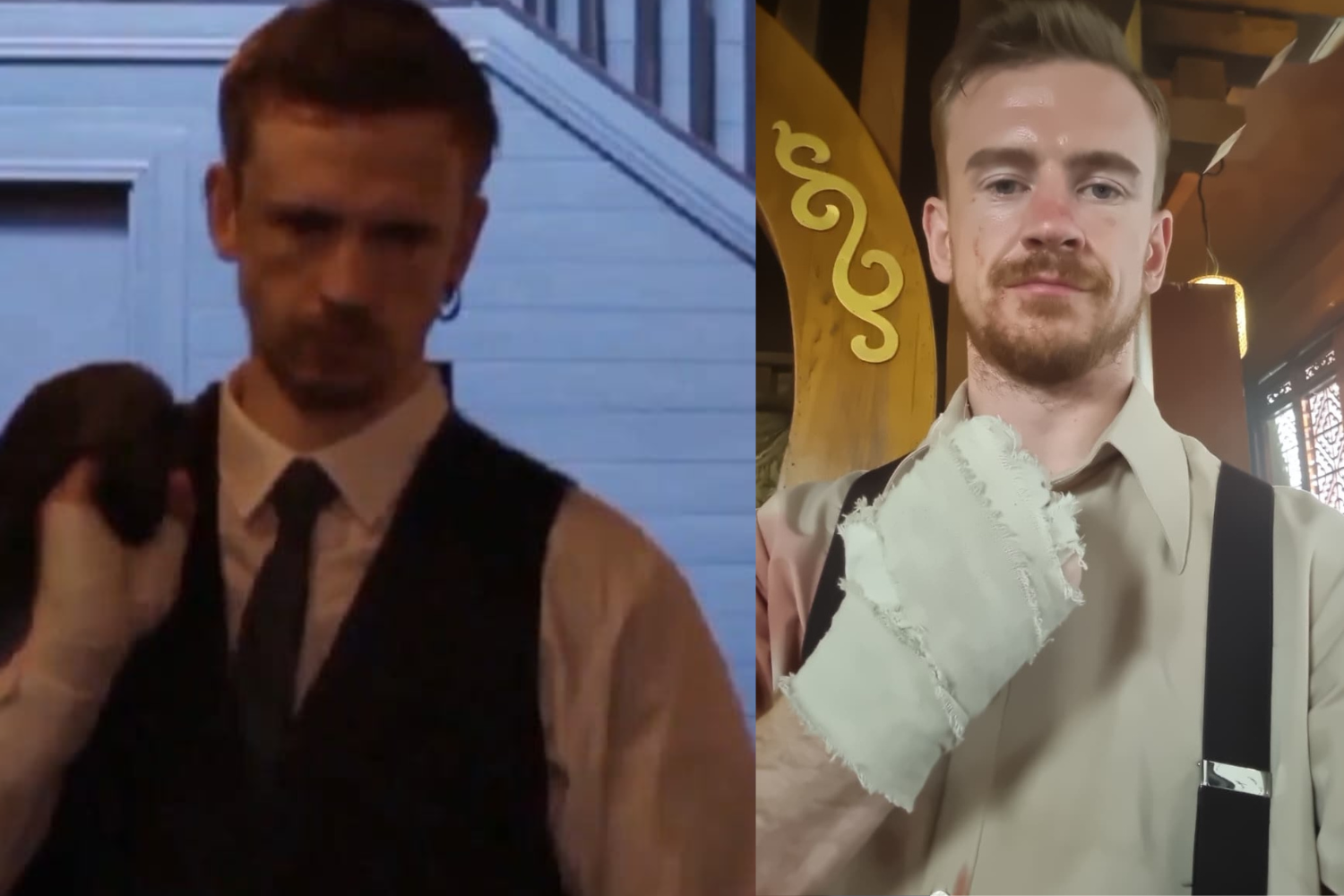
Condron played a character called White Knuckle, a boxer who wore a business suit, with white boxing hand wraps.
“It was a terrible, terrible film,” he says, laughing. “Just awful.” But it became the foundation from which something started to grow.
Condron decided to actively pursue a career in stunt performing after making that short, he says.
He broadened his training to include rock climbing, scuba diving, swimming, kickboxing, acrobatics, gymnastics, weapons training and Brazilian Jiu Jitsu – a grappling art in which he was recently awarded his purple belt at the Jorge Santos Academy, on Parnell Street.
Although the stunt performance scene in Ireland is relatively small, Condron soon found work with one of the main stunt organisations here, for a period.
This led to his work on Martin McDonagh’s The Banshees of Inisherin (2022), where he stunt-doubled for Colin Farrell.
Some of his other stunt performance credits to date include feature films Disney’s Disenchanted (2020), The Racer (2020), The Last Duel (2021), The Northman (2022) and Cocaine Bear (2023).
On The Racer, a cycling movie, he says he earned some early respect among peers for performing a stunt where he had to flip over the handlebars of a crashing bicycle.
His first credit as “stunt coordinator” came in the Danish film production Empire (2023).
Among his many television credits are Irish productions like Kin and Hidden Assets and the international hit series, Vikings.
Condron is proud of the fact that some of his own students were hired to work on Vikings as stunt performers as well.
As he also continued to work on the film making and cinematography aspects, he was always uploading his own shorts and DIY fight scenes to social media.
This wasn’t necessarily the way it was traditionally done in the circuit in Ireland, he says, and he faced some obstacles because of it.
So, he struck out on his own – as a free agent.
In 2023, Condron was one of hundreds from around the world who applied to join the international Jackie Chan Stunt Team (JCST) Action Film Camp in Beijing, China.
The stunt reels that he would choreograph, film and edit himself and upload to Instagram caught the eye of Philip Sahagun, who co-hosts the camp with the JCST.
For Sahagun, accepting Condron as one of the 30 participants was an easy choice, he said by phone from his martial arts academy in Las Vegas, on Tuesday.
Everyone who goes is handpicked based on their artistic background, Sahagun says. They don’t necessarily have to be martial arts experts specifically, he says.
“They have to have some kind of artistic training, whether that's filmmaking, martial arts or maybe an ex-gymnast who shoots short films in an interesting way,” he says.
Condron had already been producing really clever and well-shot action content, he says, so it was a no-brainer.
In fact, he was invited back to the camp again in 2024 and 2025.
The 10-day bootcamp involves physical training with members of the JCST, in specific methods developed by the team across its 50-year history, says Sahagun.
Among the challenges, participants must also group together and shoot their own short action films, and turn them around quickly.
Then, the shorts are watched and critiqued by the stunt team members.
Condron stood out immediately, Sahagun says – not only in his physical abilities, but his leadership too.
Condron is able to “absorb and find strength in various members of his team”, Sahagun says.
Across the three camps, there's been no time where he hasn't had more than three different nationalities on his team, says Sahagun.
“That kind of working dynamic in a high-pressure environment, for some people would easily go south. But Philip has done some of the most powerful short film attempts in the camp,” he says.
It didn’t go unnoticed by the Jackie Chan Stunt Team.
At the end of the camp this year, the crew were getting ready to head out to do some sight-seeing around Beijing, when Sahagun got a call, he says.
It was from Jerry Liau, a JCST member.
Liau asked if Sahagun thought Condron would be interested in a role in Ip Man: Kung Fu Master.
Condron jumped at the chance.
He had to return to Ireland for a week’s filming on Vikings, before he travelled back to Beijing for several days shooting.
There he had one of the most surreal moments of his life, he says.
On the set, before a take, Condron looked down at his own hands, which were dressed in white boxing wraps.
In a reflection, he saw himself in a suit that the costume department had put him in.
And it dawned on him, he says – “Holy shit. It’s White Knuckle!” he thought to himself.
It had all come full circle.
From the “terrible, terrible” first short film he made with friends in 2016, to the Ip Man film set in Beijing.
In that moment, it was all worth it, he says.
From being bullied as a teenager, to his first karate classes. Trying to break into the stunt industry. The constant slog, the training and upskilling, the self-doubt and negative external voices.
It had all finally clicked, he says.
“I nearly broke down in tears, but I was in the middle of a take, so thankfully I didn’t,” he says, his eyes wide open, his voice filled with excitement.
If you want to be successful in the action film world, you have to constantly grow and innovate, says Sahagun.
There are levels in the industry, he says.
Like stunt performer, and stunt double. Then up to action designer or fight coordinator, he says.
Action director is even higher, he says, and that’s where you need to aim if you want a long career. “There’s a lot more than just the martial arts part.”
“The scaffolding of the industry is to learn how to become an action director, and I think Philip is quickly learning all the skills he needs to do that,” he says. “Which are editing, sound design, shooting, constructing a scene.”
Condron says his goal is to continue growing the standard for action design in the country through Screen Combat Ireland. “And build the next generation of talent, while representing Ireland internationally as a performer and designer.”
Ip Man: Kung Fu Legend, directed by Li Liming, is due for release in January.
Funded by the Local Democracy Reporting Scheme.

It’s timely, says Alison Field of Labour, with the 85th anniversary of the devastation approaching and the world as it is.

Libraries aren’t just places to pick up books these days, says Aisling Earley, a library assistant.

It showcases films made on a short timeline with zero budget. "It's definitely a shit show, the no-budget, DIY spirit of it," says Morgan Savidan.

"We're kind of slagging ourselves, calling ourselves The Watchers."