

Draft Kylemore masterplan disrespects the city’s oldest Traveller site, say reps
For a start, it shouldn’t allow for up to 15 storeys over the road from the bungalows of Labre Park, says the coordinator of Ballyfermot Travellers Action Project.
For a start, it shouldn’t allow for up to 15 storeys over the road from the bungalows of Labre Park, says the coordinator of Ballyfermot Travellers Action Project.

“It’s going to make it a hell of a place to live,” said Shay L’Estrange, the coordinator of the Ballyfermot Travellers Action Project (BTAP) earlier this week.
He had spent the morning at his desk, he said, looking over the latest iteration of the draft Kylemore Masterplan.
It’s the blueprint for up to 5,300 homes, a new transport interchange, school site, and community facilities, on vast banks of industrial lands that sit between Inchicore and Ballyfermot.
Councillors held a special meeting on Friday evening, agreeing the latest round of changes. The draft masterplan, with those amendments, is to go out for another round of public consultation soon.
One discussion point at the meeting – the one that L’Estrange is most exercised about, he says – is the suggested heights at the project’s fringes.
Planners have lowered them in the latest draft, from the last, based on submissions.
But they have set them lower at the eastern edge where the new developments are to abut wealthier settled housing in Inchicore than at the western edge, next to Labre Park, with its Traveller bungalows.
“It’s just disrespect for the community altogether,” said L’Estrange.
Other feedback from BTAP had been brushed past, he said, like the need to preserve Traveller horse culture, with facilities to allow horses to continue to graze on lands by Labre Park. That grazing strip is now marked on the plans as part of the linear park.
BTAP also asked the council to make good on the long-standing promise to find more land for Traveller housing and earmark it as such, he said.
At Friday’s meeting, senior planner Malachy Bradley said that the council had reshaded diagrams in the latest variation of the plan, to make a step-down in heights clearer at the site’s edges.
But People Before Profit Councillor Hazel De Nortúin said that the changes didn’t go far enough next to Labre Park. “It’s the only issue I have with the site.”
The homes in Labre Park are one storey, she said, and the nearby heights over the road to the east of that allow for up to 15 storeys. That baffles her, she said.
Buildings would be like watchtowers, she said.“I think if we pass it with that level of height on it, we are doing a huge disservice to the Traveller community.”
Dublin city councillors voted to put the officials’ recommended changes into the draft plan, including with the heights as laid out by Bradley – and send it out again for public consultation.
L’Estrange said he still wants consultation on the heights with Travellers, to talk through possibilities with council officials.
The council hadn’t reached out to them directly about the masterplan and he hadn’t been aware of it, he said, before a heads-up from community worker John Bissett.
“It was just by chance that we found out about it,” he said.
The draft Kylemore Masterplan covers 52 hectares, a mash of mostly private and some public lands which currently host in-use and vacant warehouses, and giant car parks, and big ESB batteries.
The lands are part of the much larger 700 hectare area that falls within the City Edge project, on the western fringes of the city, which the council has estimated has the potential for as many as 40,000 new homes.
Council planners have been drawing up a masterplan for the Kylemore lands, as it prepares to rezone them.
The masterplan is to slot in the city’s development plan and guide what can be built in the decades ahead.
While the Land Development Agency is expected to take over lands from Irish Rail and CIÉ, the Office of Public Works, and ESB, most of the lands covered by the Kylemore Masterplan are in private ownership, says a council report.
“As such, a plan-led and urban design centred approach is imperative to achieving positive and sustainable outcomes in individual development proposals,” says the report.
The first masterplan draft went out for public consultation between 12 December and 21 January 2026, and got 100 submissions.
Friday’s meeting was to review Chief Executive Richard Shakespeare’s responses to those submissions, and make changes based on them – before sending it out for another round of feedback.
While highlighting some concerns around transport, and the school provision – which are largely out of their hands, they said – councillors were supportive of the masterplan.
Submissions from residents had been largely constructive and positive too, they said.
The draft masterplan that went out to consultation said that most of the site would be expected to be three to eight storeys.
But, there is scope for taller elements – in the west of up to 15 storeys along Kylemore Road and mixed-use blocks of up to 10 storeys, it said.
“Locally higher buildings” in the east are proposed of up to nine storeys, it said, because of the context. There were some nodes of height proposed through the site.
And also, there is provision for lower elements where they need to transition to a low-rise townscape, it said.
Much of the feedback had pointed to confusion in that description of heights, said Bradley, the planner at the meeting.
He drew up two diagrams showing the changes in height that had been made in the latest draft. A then and now.
Planners had tried to add clarity, he said, and greater prescription of lower heights at the edges where they meet existing buildings.
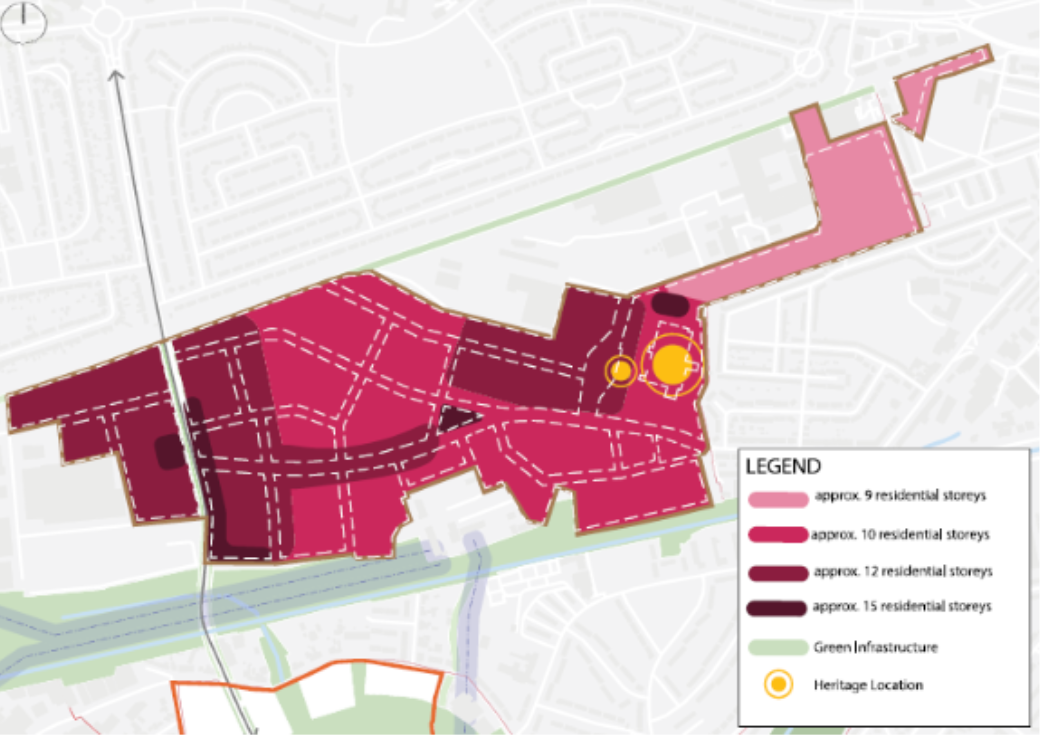
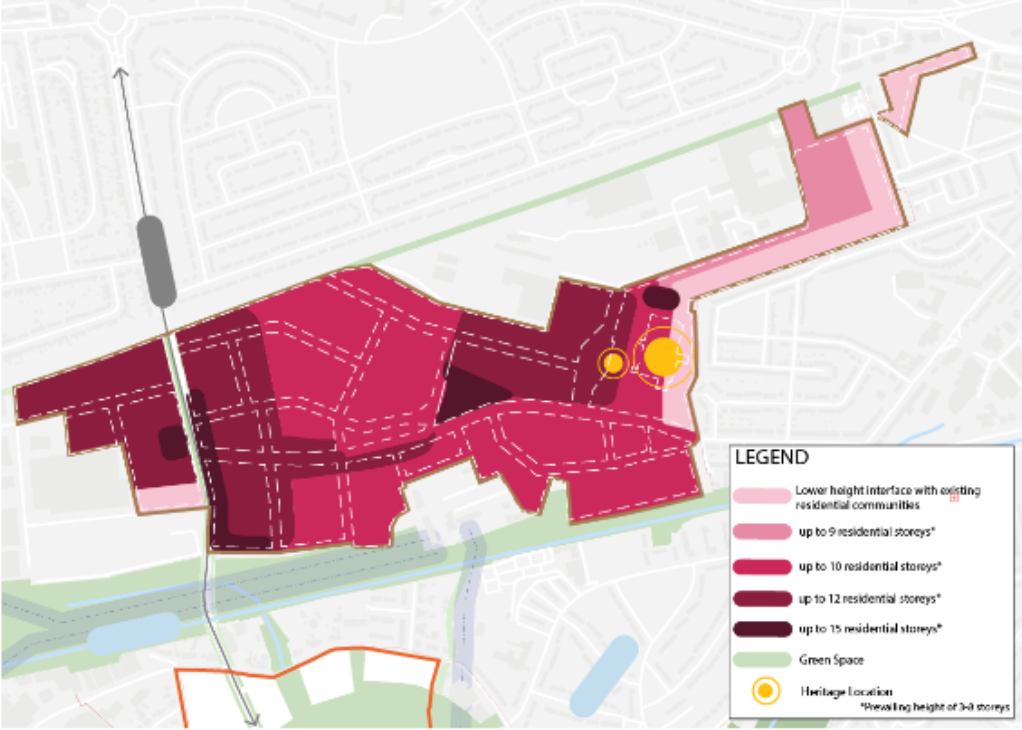
Old draft masterplan heights, as of the last consultation (l); new draft masterplan heights, to go out again for consultation (r)
At the east edge where the site reaches St Patrick’s Terrace and Abercorn Terrace in Inchicore, the diagram now shows a belt of low-rise homes, stepping back to plots with up to nine storeys.
At the west edge, where the site runs along the northern edge of Labre Park it shows the same low-rise buffer, with blocks of up to 12 storeys behind that. Over the Kylemore Road from Labre Park, the plans show up to 15 storeys.
The idea is for higher heights around the transport interchange next to Kylemore Road, where there is a plan for a Dart station and lots of buses, said Bradley. That’s the core town centre.
Bradley said they had changed the heights that back directly onto Labre Park to make them sensitive to the Traveller site.
Fine Gael Councillor Patrick Kinsella asked how the amendments to heights would affect the number of homes.
The range has not changed, said Bradley.
It’s still between 4,000 to 5,300 homes depending on densities within each plot, he said. “We’ve moved layouts but we haven’t particularly lost a significant quantum of land.”
Cian Farrell, a Social Democrats councillor, meanwhile, pressed for higher buildings.
Putting aside the question of Labre Park, he said, “is the reality here that they’re actually not … that they are too small?”
“How can we, going forward, look at more densities?” he said.
Bradley, the council planner, warned of conflating two different things. “I suppose to use the old oxymoron, higher density doesn’t necessarily mean greater height.”
High densities can be delivered at a moderate height, he said. There are also challenges with financial viability and microclimate in delivering buildings of significant height, he said.
These were also key points of debate for councillors in the north of the city, as they rezoned an industrial estate in Glasnevin.
Proposed heights impact the prices of what is delivered, the size of the apartments, whether apartments end up for owners or investors – and even whether anything gets built at all.
 Laoise Neylon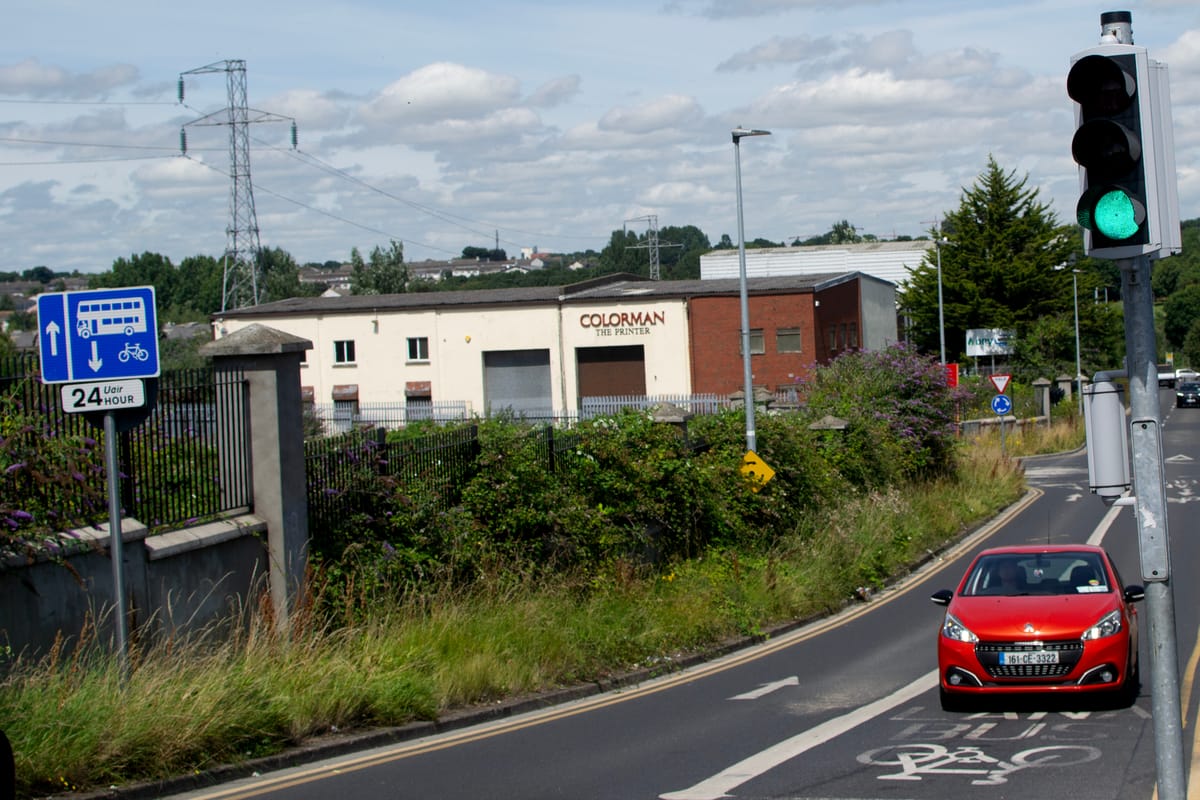
Both De Nortúin, the People Before Profit councillor, and her party colleague Conor Reddy, said they wanted their reservations about the latest draft, and its impact on Labre Park, noted.
“If it was a settled community in a different area, those heights wouldn’t go ahead,” said De Nortúin.
L’Estrange, the BTAP coordinator, said the western end of the site might be earmarked as the core town centre, the place to build with the greatest heights, because of the largely industrial lands and the big road running through.
But there’s a reason why Labre Park was built out there on the edge by itself, he said.
It was a consequence of the Report of the Commission on Itinerancy in 1963, he said, which said Travellers had to be accommodated.
“But the sting in the tail of that was that they accommodated them only as a staging post to move them into settled accommodation,” he said. The longer-term aim was assimilation, he said.
“They selected the worst possible area, on the edge of society, and it was built on a dump,” he said. “Kylemore Road would have been one of the busiest arteries at the time, so you wedge it in the most unappealing part of the constituency that you can find.”
“This is a continuation of the undermining of the Traveller community,” he said, of the draft plan.
 Laoise Neylon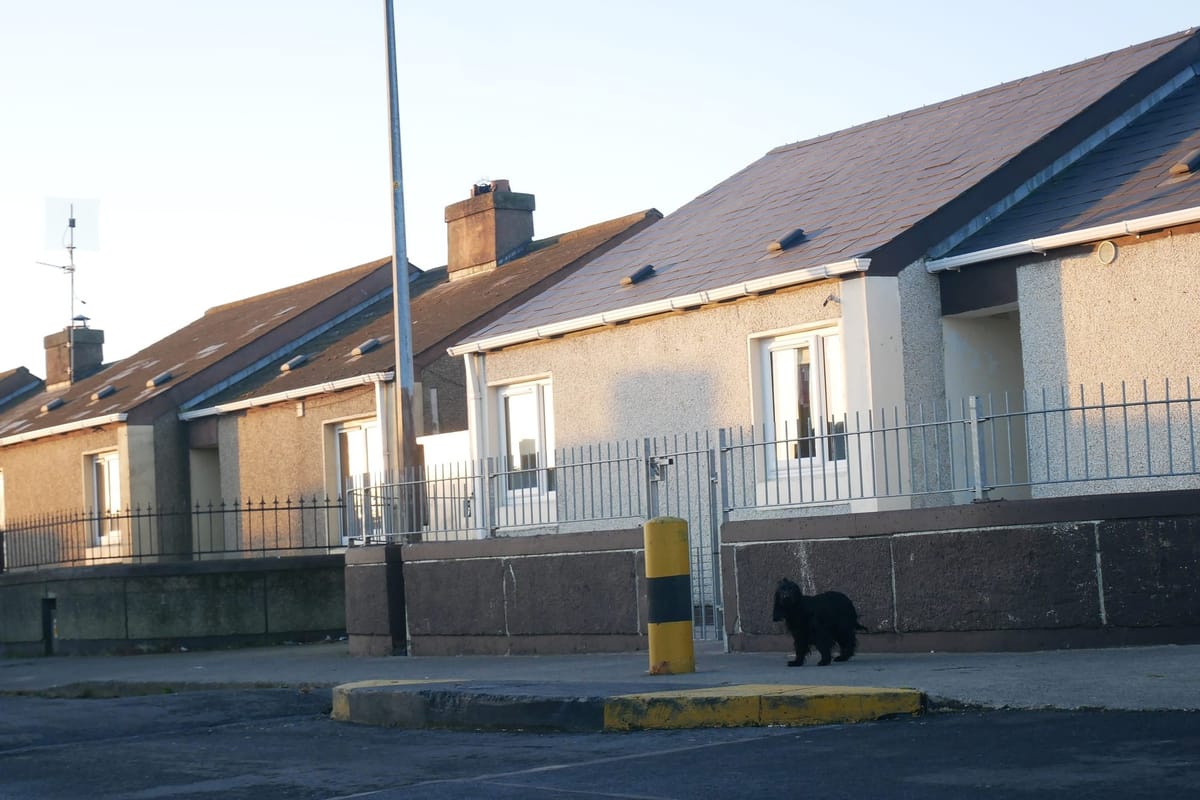
L’Estrange had also asked in BTAP’s submission that the council incorporate facilities or spaces for horse accommodation.
The planned linear park would overwrite where some people now graze their horses on the canal bank, he said. “We obviously had a problem with that.”
The council chief executive’s written response noted that the council’s policy was “to recognise the identity, culture, tradition and history of the Travelling people and to work to reduce the levels of disadvantage that Travellers experience”.
But “given the strategic nature of the Masterplan, the identification of an area for the keeping of horses may preclude development from occurring”, it said.
At the meeting, De Nortúin also asked when officials in the council’s planning and housing departments were going to come before the Local Traveller Accommodation Consultative Committee to show which new lands they have identified for Traveller accommodation.
Officials have promised, for years, that they would hustle to identify new lands for new Traveller housing.
“Labre Park is the oldest Traveller site in the city, and if there is going to be housing coming in across the road, I am expecting and presuming that Traveller accommodation will be included in that,” said De Nortúin.

Some residents in the north inner-city are worried about how the new line will impact them, as their homes are very close to the tracks.

In 2024, 29 percent of housing applications to councils across the country – for 5,626 households – were closed due to the applicant’s failure to communicate.

But while the concerns have piled up, the way forward is less clear.

In a council survey, only 62 percent of centre members said they’d travel to its new location.