

Ruling sheds a small light on opaque intel-gathering on some citizenship seekers
An Garda Síochána “has developed strong links with other security services, particularly those with whom the State shares common threats to national security”, it says.
In July, the Department of Housing published new guidelines that appeared to have axed this council policy – but it apparently has risen from the dead.

A few construction workers still wandered through the Marshall Yards on Tuesday afternoon.
Already though, residents have moved into some of the 11 new apartment blocks in the housing complex in East Wall.
Signs fixed to the brown brick walls pointed to facilities like a creche and a pickleball court, beside an outdoor barbecue area.
On each of the balconies of one of the still-empty set of flats christened Carriage Hall were two black deck chairs and a table. Inside, fresh mattresses, wrapped in plastic, and laid out on bed frames.
The first phase of the built-to-rent development was completed last July, according to the DBFL consulting engineers website. It has 211 apartments, a gym, and a men’s shed, among other facilities, the website says.
The second phase was well underway last August, mechanical contractor JCPS Mechanics wrote on their website, saying the expected completion of all 554 apartments would occur in early 2026.
On Tuesday, the men’s shed was already operational. The lights were on, and a few men were busying about inside the workshop.
Alongside the men's shed and a creche, the complex is eventually set to include three shops and seven offices, according to the Marshall Yards website.
Also, a portion of the site, covering 467.1 sqm, has been earmarked as space for a food hub and exhibitions, with this dual-space occupying the ground floor of Carriage Hall next to East Road.
It has yet to be finished, with its bare concrete interior still visible behind its partially obscured walls.
Combined, these amenities listed on the site come to roughly 2,700 sqm of the 54,000 sqm mixed-use site – or 5 percent of its total groundspace.
That 5 percent flowed from a requirement set out in Dublin City Council’s development plan for 2022 to 2028, which says that a developer must assign that much of any large-scale development exceeding 10,000 square metres over to communal, community and cultural facilities.
The developer, Eagle Street Partners, did not comment when contacted on Tuesday via email to confirm which facilities within the complex made up the 5 percent.
Twelve months ago, councillors were excitedly holding up Marshall Yards as the pilot project for the effective implementation of the 5 percent policy.
But in July, the Department of Housing published new guidelines around apartment design standards which appeared to axe this requirement, deflating local elected representatives who had developed the policy.
It came as a surprise then to councillors and non-elected members of the council’s arts committee on Monday morning, when Brian Keaney, the acting deputy city planner said that – in the council’s interpretation of the guidelines – the policy would still apply to lots of the city’s future developments.
When the Department of Housing issued its new design standards for apartments in July, the council’s artists workspace committee was still only in the early stages of rolling out the 5 percent policy.
City Arts Officer Ray Yeates had been engaging with developers since November 2023 to help them understand and appreciate the need for the policy, he had said.
The Arts Office had even gone so far as to set up a registry for arts and cultural groups who were on the lookout for temporary or permanent workspaces so as to match-make with developers to whom the policy applied.
The new guidelines, though, now said that “the provision of new communal, community and cultural facilities within apartment schemes shall only be required in specific locations identified within the development plan and shall not be required on a blanked threshold-based approach in individual apartment schemes”.
That seemed to have scotched the 5 percent policy, said Moriarty, after the new guidelines came out.
On Monday though, Keaney, the acting deputy city planner, told the committee that, while the guidelines do impact on the development plan, there are lots of developments to which the council considers that the 5 percent policy will still apply.
The change is that before the guidelines, “we could apply this policy blanketly across the city. We can no longer do so,” Keaney told members of the Community, Gaeilge, Sport, Arts and Culture Strategic Policy Committee.
But the policy still applies to large-scale developments exceeding 10,000 square metres which aren’t mostly residential, he said – those that are mostly commercial and mixed-use. “So it’s only in the residential, where it’s really kind of ring-fenced and affected. The commercial schemes aren’t.”
It also still applies in areas that are zoned Z14 in the council development plan, he said.
The latter are SDRAs, of which there are 17 across the city, including Balgriffin, Belmayne, Clongriffin, Ballymun, Cherry Orchard and the Docklands, he said.
It can also be used in places where local area plans identify a need for more communal space, he said. “When planning applications come in on the back of those particular plans and strategies, we can require the delivery of [the policy] CU025 in those areas.”
This, in a nutshell, is the council planning department’s interpretation of the guidelines, he said.
Has the council’s interpretation been challenged yet? asked Moriarty, the Labour councillor.
Not to date, Keaney said. “I think, in fairness, we engaged early with all parties.”
The pool of private developers is a lot smaller these days, he said. “Those that are out there tend to be well established, and they know the requirements.”
They know that these requirements have to be delivered, he said. “And the alternative is that you’re refused planning permission.”
The Minister for Housing James Browne, a Fianna Fáil TD, has also suggested that his department’s new guidelines – undermining the 5 percent policy – could be retrospectively applied to developments that had already been granted permission, Moriarty said.
“Are we aware of any notifications that we have received on that basis where our 5 percent will now no longer apply?” he asked.
Under the new Planning and Development Act, there is provision for a developer who hasn’t commenced works on an approved scheme to, in theory, amend the internal layout, Keaney said. “Now, that provision has yet to commence in legislation.”
It’s not operational, but there will be challenges around that, he said.
To date, Keaney said the council has approved just over 40,000 sqm of arts, community and cultural floorspace as part of planning applications. “Of that, a majority of it is within the Z14 lands.”
Going to planning is the easy part, he said. “The big challenge is around the delivery and the economic viability.”
The committee remained on the topic of cultural spaces after Keaney wrapped up his presentation.
Green Party councillors Donna Cooney and Janet Horner had put forward a motion, asking the council to consider purchasing Clonturk House and Cottrell Lodge in Drumcondra with a view to repurposing them as cultural buildings.
The two buildings and surrounding grounds were listed for sale by estate agents Knight Frank on 21 January, on MyHome.ie.
Clonturk House was built circa 1820 by the city architect, Cooney told the committee. “So there’s connections to Dublin City within that.”
The boundary walls around the house are also made from the balustrades that previously made up Carlisle Bridge, now O’Connell Bridge, she said.
Local Thomas Dudley, better known as Bang Bang, spent his final years in the care of the Rosminians at Clonturk House between 1977 and 1981.
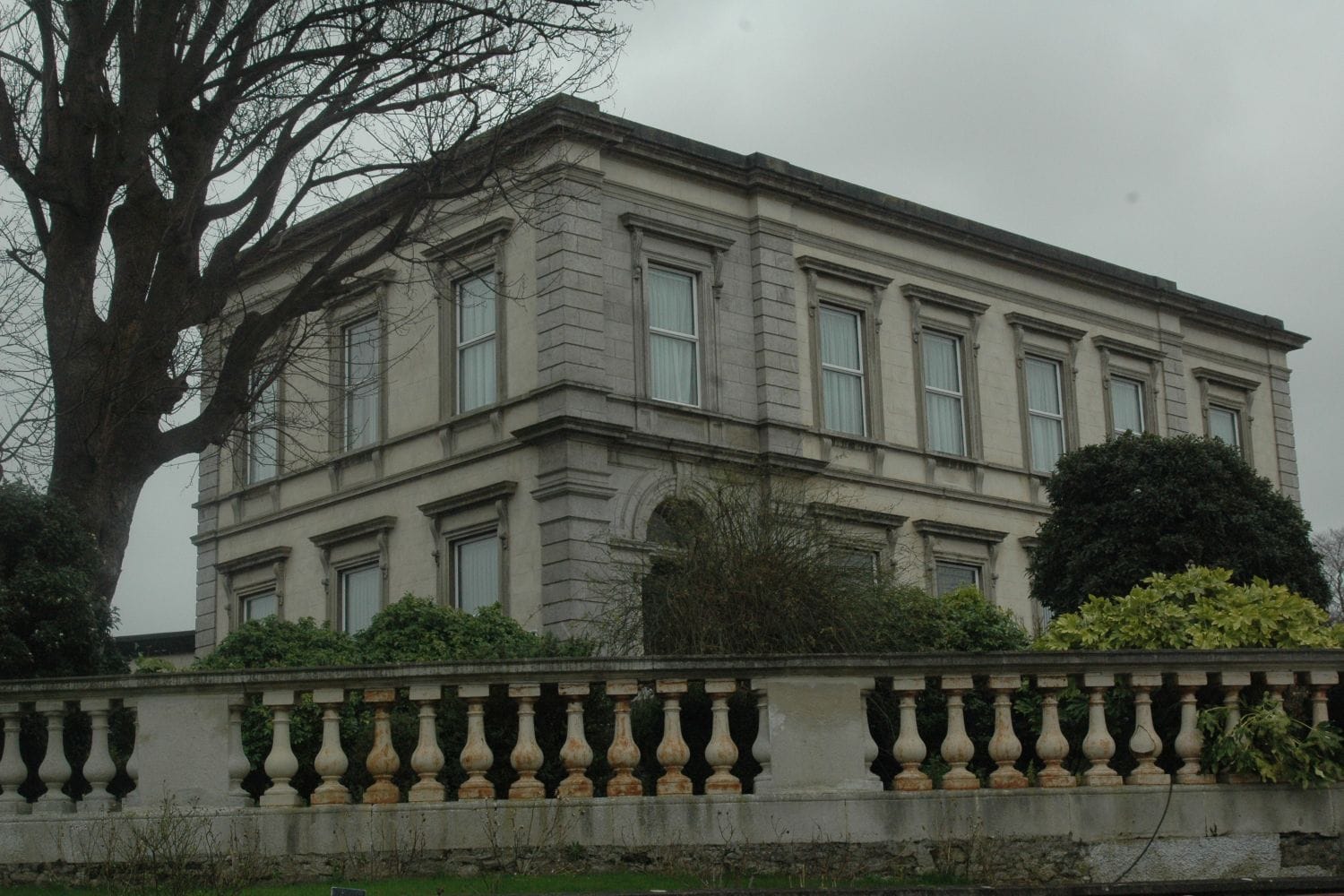
The building has office rooms, approximately 16 ensuite bedrooms, a library and several communal living areas, according to the Knight Frank brochure.
Meanwhile, Cottrell Lodge, an adjacent two-storey block on the same grounds, dates to the 1980s and has about 10 bedrooms, the brochure says.
The site is zoned Z2, “Residential Neighbourhoods”, and could be used for housing, student accommodation, healthcare or education, the estate agent’s site says.
But there are a lot of high-density buildings in the area, and not a lot of cultural space, said Cooney.
David Dinnigan, the executive manager of the council’s Culture, Community, Leisure and Area Services Department, said the proposal wasn’t feasible.
His department doesn’t have the capacity at the moment to take on a project of this scale and cost, he said in a written report.
“The property in question is not in Council ownership and would require the council to compete in the open market to secure the property in a very short period of time,” Dinnegan wrote.
Bringing the properties up to code too would require multiples of the asking price, he said.
Owing to the 5 percent policy, a lot of cultural and community spaces are set to become available in the coming years, he said. “These will provide modern spaces that will not require such significant remedial investment and should be prioritised.”
While he ruled out the possibility of redeveloping Clonturk House, Dinnigan said the council also currently has a working group that is looking to open a new arts centre in the council’s administrative North Central Area.
That group is working on two specific schemes, he said. “One of them is on the Oscar Traynor Road which is going to offer absolutely amazing potential for sport, community and the arts.”
They are looking into how that site can be developed at present, he said.
Cooney, as a member of the working group, said it was the first she had heard about this potential new site on the Oscar Traynor Road. “I’m glad to hear that there’s something in the possible pipeworks.”

An Garda Síochána “has developed strong links with other security services, particularly those with whom the State shares common threats to national security”, it says.

Complaints about waste clothes strewn around clothes banks spiked early last year – as did questions around where the deposited clothes actually end up.

Dublin City Council stopped using it in 2018, due to concerns that it was carcinogenic.

A recent public consultation found that, yes, loads of residents want a sports pitch, but also that many are sceptical it will happen.