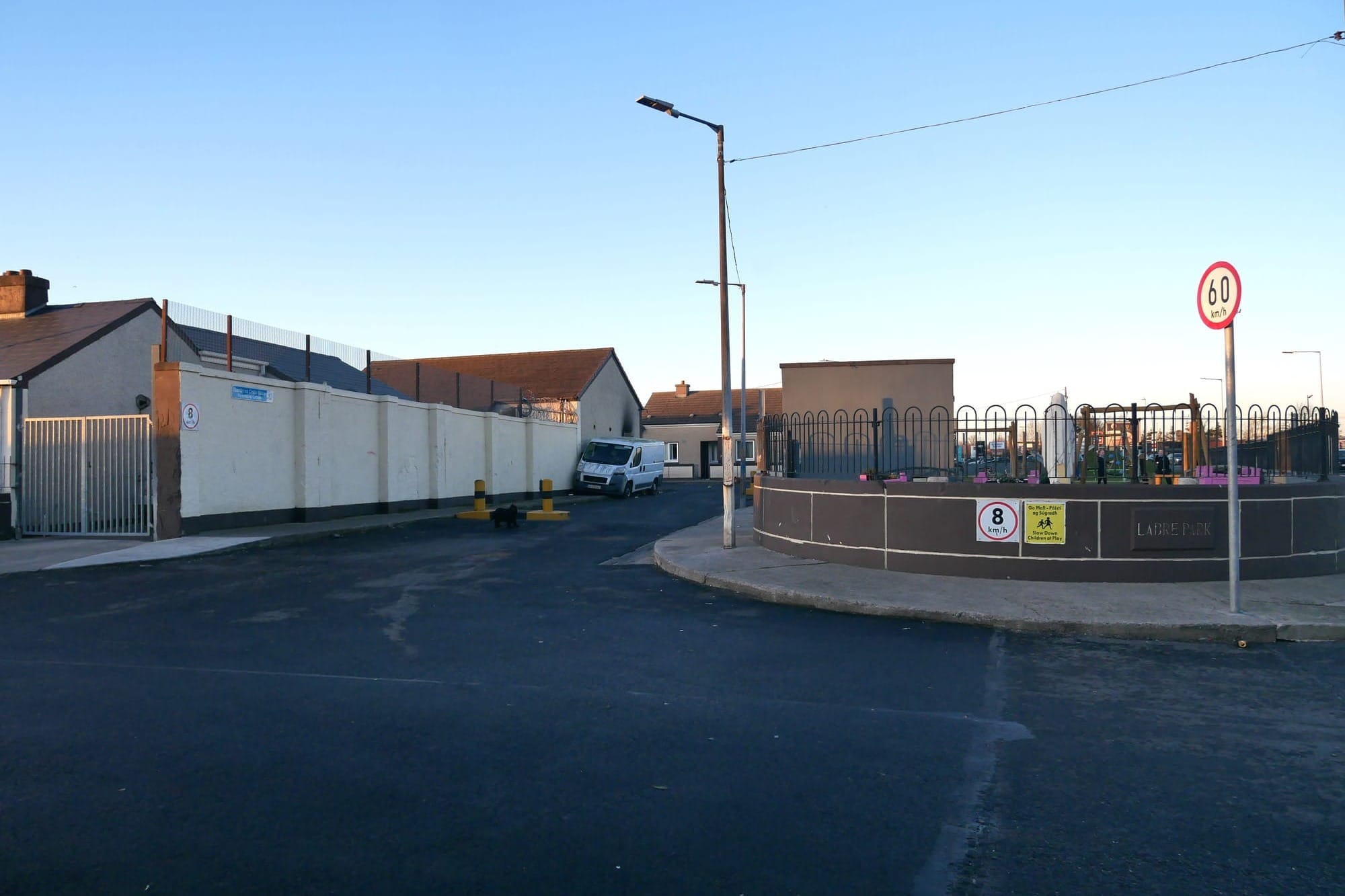
After 30 years, the finish line for the project was supposed to be close. The cost of the u-turn will be even greater homelessness, said the coordinator of Ballyfermot Traveller Action Project.
Council breaks promise, again, of new homes for Travellers at Labre Park
After 30 years, the finish line for the project was supposed to be close. The cost of the u-turn will be even greater homelessness, said the coordinator of Ballyfermot Traveller Action Project.
In December, Dublin City Council officials were talking about how pleased they were with progress towards the construction of new homes at Labre Park, the country’s oldest Traveller site, in Ballyfermot.
But then, last week, Shay L’Estrange, coordinator of the Ballyfermot Traveller Action Project (BTAP), got the call that the new-builds are off.
Better living conditions on the site, where overcrowding is acute, have been promised for almost three decades.
Recent plans, agreed with residents, were for 12 new-build homes and the significant regeneration of 18 existing homes.
The cost of the council’s failure will be even greater homelessness among Travellers and an even worse mental health crisis, said L’Estrange on Thursday.
In the last six months alone, BTAP has arranged for three families to move out of Labre Park and into homeless accommodation, said L’Estrange.
As the next generation forms relationships and has children, they just can’t stay, he said. “There’s just no room for them.”
Other residents, meanwhile, have moved out with the promise that one of the new homes would be set aside for them, he said.
The council evicted one man from a bay he had reopened, on the grounds that he was blocking the regeneration, said L’Estrange. “He was given a one-bedroom flat in Bluebell. It’s mentally killing him.”
The council has decimated the community at Labre Park, said Hazel de Nortúin, a People Before Profit councillor. “They don’t even see the uneducated approach they’re taking on Traveller-specific housing rights.”
The council is clearly following a programme of assimilation, she said. In other words, refusing to acknowledge and support Traveller culture and making Travellers live like settled people.
De Nortúin said she plans to speak to all parties, councillors and the lord mayor, to seek their support to get the regeneration plan reinstated and moving.
“Any councillor that doesn’t see the need to redevelop this site isn’t for cultural diversity within our communities,” she said.
Dublin City Council hasn’t responded to queries sent by email on Thursday afternoon.
The given reason
Council officials, including Mick Mulhern, the head of housing, have said that the new homes can’t be built because of the flood risk, said L’Estrange.
That’s not a new issue. It was raised before, including by senior council engineer Gerard O’Connell, in the council’s Flood Projects and Water Framework Directive Division.
But BTAP and residents were told it was resolved, said L’Estrange. “They’ve changed their mind and put it back on the table again.”
After the issue of flood risk had been raised in 2019 and 2020 by council engineers, Clúid, the housing charity – which was leading the project at the time – had agreed a new plan with the council.
It wouldn’t build on the side of the site nearest the canal bank.
They would also include some flood alleviation measures in the project.
One proposal commissioned by Clúid had been to take from the canal bank and develop a sink, and kind of tub for water to flow into, to prevent Labre Park from flooding, said L’Estrange.
But that was costed at €7 million or €8 million, he said, largely because they realised Labre Park had been built on a dump, so soil would have to be decontaminated
Nobody – not the Office of Public Works (OPW), not the council, not the department – wanted to take responsibility for funding that though, said L’Estrange. Not for the number of homes in question, he said.
The OPW has been criticised in the past for its narrow calculation of cost-benefit when assessing flood-remediation projects.
Clúid came back with another plan anyway – building a simpler flood wall.
That proposal was circulated within Dublin City Council a little over a year ago, said L’Estrange.
It was sent around internally as part of what is known as the pre-Part 8 planning process, to get feedback from all divisions – including from engineers and drainage.
It appeared to get the all clear, he said. And while Clúid left the project, the council had said it was still progressing it alone.
Until last week, when L’Estange had those calls from the council’s Traveller Accommodation Unit, and from Mulhern too, to say that the new-build homes were to be scrapped.
“So we’re back to square one, back to 1999,” he said.
What about the Camac flood scheme?
One objection to progressing Labre Park, raised in years past by council engineers, was that the whole area needed to be looked at as part of the Camac River Flood Alleviation Scheme.
That’s a big project being progressed by Dublin City Council, South Dublin County Council, and the Office of Public Works.
They have been looking at measures to protect as many as 1,352 homes in the Camac basin from flooding in the coming decades, said Gerard O’Connell, during a presentation to councillors in April 2024.
At that time, they were looking at three possible bundles of options.
One option included, among other measures, the flood wall near Labre Park.
That should help alleviate flood risk there, O’Connell told councillors at that meeting. “So that should be possible to develop that.”
But while the flood wall was included in one of the package of options being looked at, exactly what interventions the OPW and councils have settled on as their favoured measures isn’t yet public.
The OPW hasn’t responded to queries sent Thursday asking if that wall is planned as part of the Camac River Flood Alleviation Scheme, and if not, why not.
It also didn’t respond to a query as to whether alternative interventions can be looked at to enable the homes at Labre Park, or whether any of its modelling shows what impact other interventions would have on the risk of flooding to these homes.
In November, Dublin City Council had put in to the Department of Housing for funding for the Labre Park project.
That included money to cover flood remediation and decontamination, according to a written response to a councillor in December, from Chief Executive Richard Shakespeare.
That application is still under consideration at the moment, said a spokesperson for the Department of Housing on Thursday afternoon.
But that hasn’t stopped council officials from telling L’Estrange that they are not moving forward with the new homes, that the flood risk is too great.
Not even the refurb?
Families at Labre Park have spent so much time engaging with the proposals, despite their disbelief that the council would ever come through, said L’Estrange on Thursday.
When he told people the situation at a community meeting the night before, many reminded him that they had said it would never be done, said L’Estrange. That any promises would just be broken.
And now the council has just pulled the plug, he said. “It’s just a prime example of how the Traveller community is treated.”
Green Party Councillor Ray Cunningham said his understanding is that the refurbishment of the existing homes will go ahead.
Conversations with officials mean L’Estrange isn’t confident even of that though, he says.
The first phase of the regeneration was to be a new community centre and a massive upgrade of the existing homes, he said, with wraparound insulation, solar panels, and extensions.
Clúid had assessed the existing houses and found the bedrooms and rooms were too small, he said. They had plans to move internal walls, and knock joining rooms together for space, and add extensions to make up for any loss of rooms, he said.
Mulhern told L’Estrange that upgrades are going ahead, said L’Estrange.
But L’Estrange asked where the money is to come from, he said. Have they made a separate application for funding for all that to the department and got the go-ahead?
He didn’t get a clear answer, he said. “The more I thought about it, the more suspicious I became.”
Council workers have sent a note asking for access to homes in Labre Park to review what maintenance is needed, he said.
But as he sees it, that’ll involve small stuff. Boiler upgrades and new doors, he said, and the smaller interventions that they can cover out of existing budgets.
Over the road
Meanwhile, debate within the council chamber in recent months has been focused on smoothing the way for the redevelopment of a vast swathe of underused industrial lands that spreads eastwards, over the road from Labre Park.
Councillors are moving to rezone the area, and set out what can be built there with a new Kylemore Masterplan, covering this stretch between Inchicore and Ballyfermot.
Labre Park sits just outside the draft masterplan area, with maps showing that any new buildings just over Kylemore Road may rise to up to 15 storeys as part of the new neighbourhood town centre.
De Nortúin, the People Before Profit councillor, said that she now wants the Labre Park project linked in as part of the masterplan. “That shouldn’t proceed without.”
She is looking at how to do that, she said. But first also wants to make sure that such a move wouldn’t delay any redevelopment of Labre Park further, she said.
She said that officials have suggested that Travellers would be offered apartments in the masterplan site.
They’re ignoring that they must deliver Traveller-specific accommodation, she said. Homes that respect and enable Traveller culture.
L’Estrange, the coordinator of BTAP, said that he made it clear to officials that he sees their approach as assimilation by the backdoor. “And it’s disgusting.”
Cunningham, the Green Party councillor, said that building Traveller-specific housing on lands within the Kylemore masterplan area would be tricky.
Much of the land isn’t owned by the state, he said.
But also, it’s mostly planned out as high-density, said Cunningham. Allowable heights in the draft masterplan range vary across the area, though, from between three storeys to 15 storeys.
Indeed, densities and heights aren’t equivalent, he said. You can have high densities at lower heights than many people realise.
But if you take the plans for Labre Park and copy that, and put that into the Kylemore masterplan area, and there was overlooking, would anybody be happy? Asked Cunningham.
The issue then becomes a question of when and where the council is willing to prioritise and build appropriate homes for Travellers – who are discriminated against in the private-rental market and overrepresented among the city’s homeless.
L’Estrange said he has emailed all area TDs and councillors to see what they will do to support Labre Park residents.
In February 2021, councillors and officials lined up to speak of the need to end housing discrimination against Travellers in the city, and find radical solutions to the failure to provide homes.
Said then-Lord Mayor Hazel Chu of the Green Party: “If we don’t provide fit-for-purpose accommodation to Travellers we are putting a rubber stamp on racism and saying it’s okay.”
This coming Monday night, councillors are due to note the city’s next three-year rolling capital programme, the budget for big building projects set by council officials.
The funding allocation for the Labre Park redevelopment is down from €13.9 million to €2.7 million between the two programmes – and €0.6 million to explore “feasibility of land for development – Travellers” is also gone.