
Now that the council has stopped taking horse manure, it's piling up in the Liberties
“So the council is allowing horses in Dublin City,” says horse owner David Mulraney. “But they’re not allowing them to put their horse manure anywhere.”
“It’s not that the people who live there don’t have cars,” he says. “It’s that the neighbourhood is not a car park, and the car parking is on the edge.”

On Glenveagh’s website for its proposed 1,350-home Belcamp development on the northern fringes of the city, images show rows of two-storey homes.
With cars parked right out front.
A parking scheme Glenveagh submitted as part of the planning application it put in to Fingal County Council back in December reflects this vision.
“The proposed layout is highly car-dominated,” wrote Green Party Councillor David Healy, in a submission on the plans, which the council has not yet issued a decision on.
“Front gardens will be entirely given over to car parking and the visual and social impression will be of living in a car park. This will be a hostile environment for vulnerable road users especially for children,” Healy wrote.
But another way is possible, he wrote.
"The obvious alternative is to provide for car-free neighbourhoods, as encouraged by the Fingal Development Plan, whereby car parking would be in dedicated car parks on the edge of the residential areas,” he wrote.
Indeed, the council’s development plan for 2023–2029 – which is meant to guide what’s built in the county, and where and how – includes an objective to “Support development which enhances the quality of the built environment, promotes public health, and supports the development of sustainable, resilient communities.”
In particular, it “Encourages the development of car free neighbourhoods and streets, where appropriate.”
Picture, if you will, the car-free neighbourhoods of Utrecht. Or the car-lite set-up at Centre Parcs in Longford, with a big car park at the edge, and adults and kids cycling and walking and riding electric golf carts around among the houses and parks in the centre.
On the phone last week, Healy said the idea is often misunderstood.
“It’s not that the people who live there don’t have cars,” he said. “And it’s not even that you can’t drive into the neighbourhood, but it’s that the neighbourhood is not a car park, and the car parking is on the edge.”
In practical terms, he said, that would mean concentrating parking in one part of the development, rather than scattering it across streets and front gardens.
“The living environment doesn’t have cars in it,” he said. “So if you need to drive in to drop off furniture or whatever else you can – but the whole area is basically car parking up to the edge of the houses.”
It could reduce the cost of the homes, as well, some reckon.
“Parking is not free – its cost is usually hidden in the price of housing, whether residents own a car or not,” says Alex Gaio, a transportation planner at Leading Mobility. “In most developments, parking is bundled into the price of housing.”
It could also make room for more homes to be built on the same site, Gaio says.
“Dispersed, unit-by-unit parking uses large amounts of valuable land,” he says. “By unbundling parking and providing shared or edge-of-development car parks only where needed, land can be used more efficiently, potentially allowing more homes to be built and lowering the per-unit cost needed to make a development viable.”
Elaine Edmonds, a lecturer in spatial planning at TU Dublin’s School of Architecture, Building and Environment, says “Reduced-car urbanism” has been around for 30–40 years.
“The real estate prices are actually better over the course of a 10-year sort of timescale," Edmonds says.
Car-free areas can bring clear benefits, if designed well, says Conchúr Ó Maonaigh, a researcher in geography at Maynooth University.
“The overarching advantage of this design is that ‘car free areas’ should reduce congestion in urban neighbourhoods while encouraging active travel, improving air quality, and reducing the overall emissions output of these areas,” Ó Maonaigh said.
Lorraine D’Arcy, TU Dublin’s Sustainability Action Research and Innovation Lead, says car-free neighbourhoods are more livable.
“People live longer, they're more likely to know their neighbors, they are happier, they're healthier,” she said. “You know, there's loads of benefits to living in neighborhoods like that.”
Gaio, the transportation planner, points to many of these same benefits, and also others. “With fewer hard surfaces, these designs can also support more green space, better stormwater management, and reduced urban heat during hot weather,” he says.
There are challenges to designing car-free or car-lite neighbourhoods, says Ó Maonaigh, the geographer.
For starters, not everyone is able to walk five minutes or whatever from their home to a car-park at the edge of the neighbourhood, he says.
“The design should ensure that neighbourhoods are planned with 'inclusive walkability' in mind so that residents of different backgrounds and abilities can access the car parks,” he says.
“This aspect of the design is quite challenging to address but not impossible,” he says. “Ultimately, this feature of planning requires a level of co-creation with community organisations and marginalised groups throughout the planning process.”
Another issue is that this type of design “still ultimately encourages car ownership among (sub)urban residents”, he says.
Even more challenging, perhaps, is getting developers like Glenveagh to build these types of neighbourhood around Dublin.
When it comes to Belcamp, Fingal’s development plan says it “encourages” this sort of development – but it does not require it.
And developers think buyers expect to be able to park right outside their home, says Philip Lawton, assistant professor of geography at Trinity College Dublin.
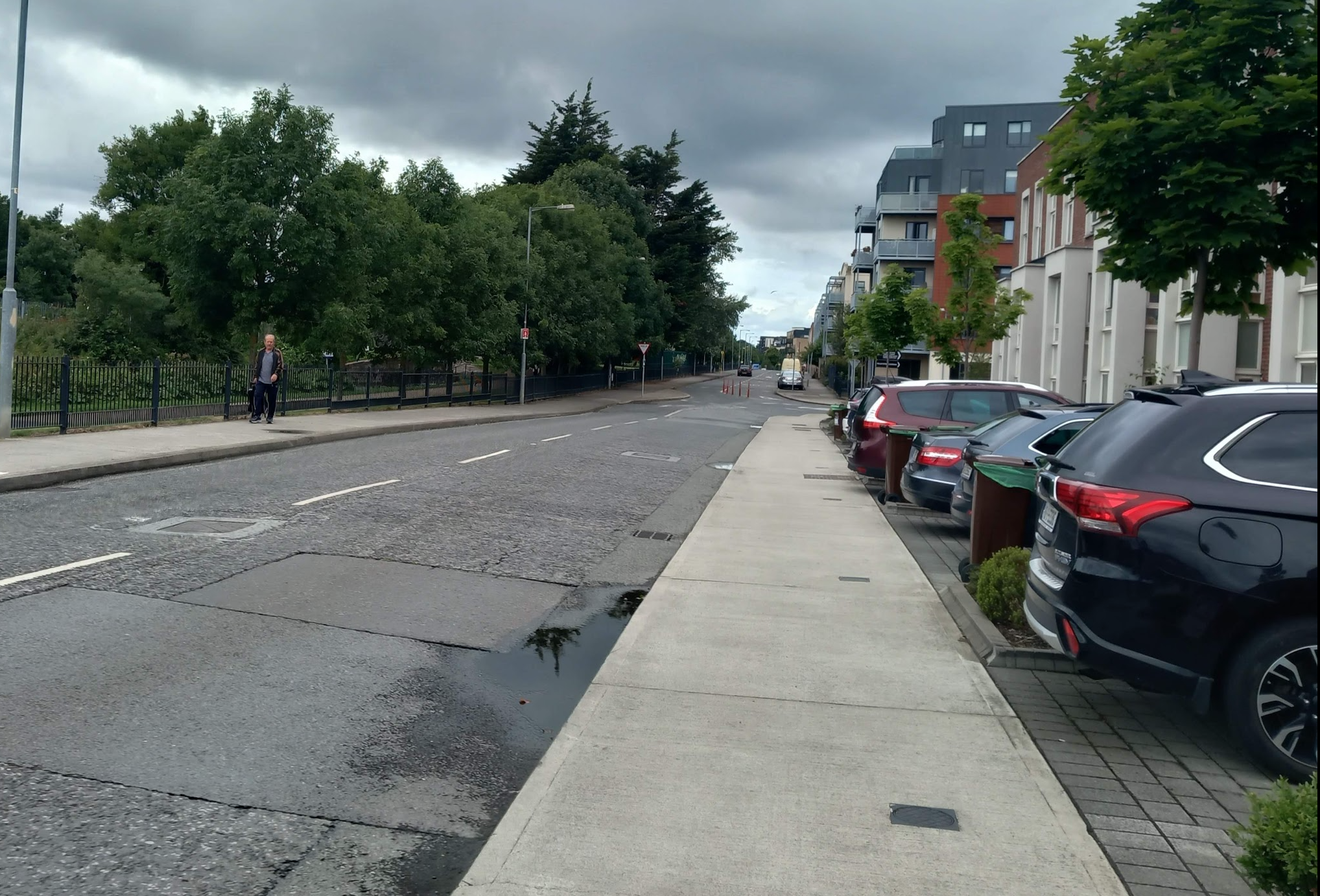
Doing this normal, expected thing is the lowest-risk option for developers, Lawton says.
“If somebody’s buying the house, it might be seen as negative to have to walk to their car,” he said. “Everyone is so used to their car being there.”
Yes, says Edmonds, the lecturer in spatial planning at TU Dublin, “People have this idea you need to be able to drive right up to your door.”
Glenveagh has not responded to queries on its considerations around creating car-free areas in new residential areas.
Funded by the Local Democracy Reporting Scheme.

The change may mean the pitches can withstand more use, but it also means they won’t absorb as much rain, or sustain as many creatures, they say.


Are there short-term responses that would help?