But a spokesperson for the charity said the position articulated by its deputy chief operations officer at a council meeting recently is not its current policy.
It’s Saturday, and the Christmas market at Smithfield – with its ferris wheel, ice rink, and hot dogs – is still up and running, but the mood has mostly dried up.
Andrea Arroyave has packed up a lot of her stall’s display, in anticipation of the conclusion of the fair tomorrow. It’s cold, and she’s had a cold for a while now, she says.
Her friend has packed up the space heater she had shared, and Arroyave is passing off the last hour of tonight’s shift to her husband in 20 minutes.
It’s been a long stretch at Twinkletown, but after this she’ll be back at her regular spots in Temple Bar, Moore Street, and Phibsborough.
As Sophie Kraft walks by Arroyave’s wooden booth, despite the smaller collection, she’s drawn in by the display’s colourful rows of Ecuadorian jewellery.
Kraft, who is visiting from Porto, in Portugal, starts browsing, and chatting politics with Arroyave in Spanish.
Later, lingering in front of the stall, Kraft says she’s lived around the world and the jewellery at Arroyave’s booth brought back her time living in South America. “All the colors and the animal prints,” Kraft says.
Various artists contributed to the jewellery on display at Arroyave’s stall for her business, Alli Tuta. All of the artists, like Arroyave, are from Ecuador, and make the jewellery by hand.
With every product, she gives the purchaser a card with the name of the artist and their contact info and a photo of them.
Artist, and middlewoman
Alli tuta means “good night” in Kichwa, Arroyave says. It’s one of the languages in Ecuador, one in which her grandma threw in phrases with her from time to time.
She said since she was a child she always loved the night stars and the moon, and she wanted to name her company killa which in Kichwa means “moon”.
A friend convinced her that would be constantly mispronounced, and so they settled on Alli Tuta.
She said it was only later when people started to call her Alli that she realised it was a name – and now it had become a nickname for her too.
Behind the counter, in the booth, Alli – Arroyave – Andrea – takes out a clipboard with the head of a snake made of knots with blue and green threads.
A macrame earring design, she said, that has been selling well lately. This piece was still at the beginning, with the snake’s head trailed by green and blue strings.
“At the beginning, when I started to do these ones, it took me a long time to make a pair. Now I can make a pair in 1 hour 15 minutes. Before, it was like two hours,” she says.
Arroyave is both an artist and a middlewoman.
When she’s back in Ecuador, she visits great artists and families she knows and learned from, or found since, and purchases large amounts of jewellery from them, she says.
Yes, she pays less than she sells them jewellery for. She says she’s always clear with the makers about that.
She buys the pieces, then ships them to Ireland and imports them, Arroyave says. She pays for this stall, her other stalls, and her time, among other costs, she says.
Sometimes she said people have questioned her on the prices, she says. She charges, for example, €35 for a pair of dangly earrings, and €25 for a beaded bracelet.
She’s had people tell her, despite the labour put in: perhaps that’s still too much. A woman from India told her the earrings would be worth about six cents in her country, she says.
“And I said that’s sad to hear. I said to her, like, basically, sorry, sad to hear that in your country, they don't appreciate the work of the artisan,” she says.
Display, and shop
Arroyave said it’s not all about selling things. Her booth is also a display, and she likes when people admire the work, she says.
“I say to them, like, feel free. Like, touch them. Look at these. Fine. You don't have to buy anything now,” she says.
There’s beaded sunflowers and birds and monarch butterfly wings, made by Rosa Guamán who she knows in Ecuador.
There’s Arroyave’s friend’s necklaces, small blue flowers pressed and set in resin. No two pieces are the same.
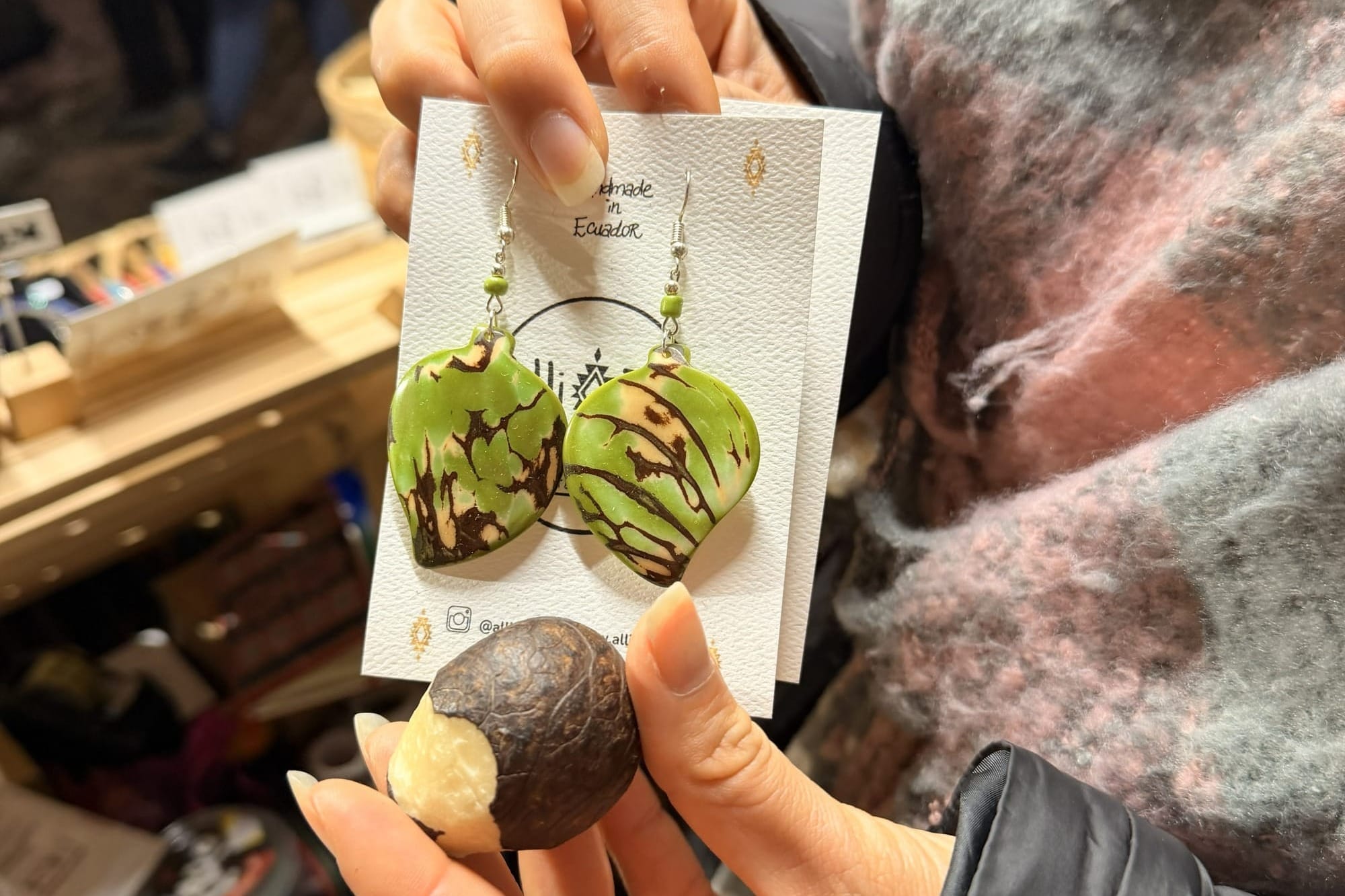
Arroyave holds up a pair of dangly, leaf-shaped green earrings with brown stripes, which she says are made by Miryan Guzñay. They’re made of a material called tagua, which comes from a palm tree, “it's also known as vegetable ivory”, she says.
Arroyave said, maybe she’s a “silly dreamer”, but she thinks there’s something deeper when you buy things from an artist who has learned how to make them from her mother, and taught her children.
“You can feel the difference. It's hard to describe why, but I feel like that's one thing I want to acknowledge … how different it is when it's not fake,” Arroyave said, before taking a sip from the Costa cup filled with hot water and Lemsip.
Vivid
Kraft, the visitor to Arroyave’s stall at the Christmas market, says the jewellery reminds her of her time in Latin America, and she misses that.
Mainly, she got drawn in by the colours, she says, and more than 20 minutes has passed and she is still hanging out here. It’s “bright, vivid”, she says.
She used to be into “nude colors and black, gray, white and beige”, Kraft says. “But now I started, like to … Yeah, to try out new things. And I like it. It's more colorful. It brings more happiness.”
Yes, says Arroyave. “Obviously, people go through ups and downs, but you can't be sad in the sunflowers”, she says, wearing the yellow sunflower earrings tucked into her long dark hair and black cap and black jacket.
A spokesperson for the board said it redacted accounts that weren’t “evidence-based” and had not tried to “hide or trivialise the scale of any crisis”.